

Toronto Condo Market: What to Expect in 2026
Condo123 · March 31, 2026
Toronto Condo Market: What to Expect in 2026
The toronto condo market has long been one of the most closely watched real estate segments in North America. As we move deeper into 2025 and look ahead, buyers, investors, and industry analysts are all asking the same question: what will toronto condo prices 2026 look like, and is now the right time to act? Whether you are a first-time buyer, a seasoned investor, or simply monitoring the market, understanding the forces shaping the next 12 to 18 months is essential for making sound decisions.
In this comprehensive guide, we examine current market conditions, demographic trends, interest rate trajectories, new supply pipelines, and expert forecasts to deliver a thorough condo market prediction toronto for 2026. We also explore how pre-construction condos fit into this landscape and why platforms like condo123.ca are becoming indispensable tools for buyers navigating one of Canada's most complex real estate environments.
Current State of the Toronto Condo Market Heading Into 2026
Before making any forward-looking assessment, it is important to understand where the market stands today. After the dramatic rate-hiking cycle that began in March 2022, the Toronto condo market experienced a meaningful correction. According to the Toronto Regional Real Estate Board (TRREB), the average selling price for a condominium apartment in the Greater Toronto Area (GTA) fell from a peak of approximately $779,000 in Q1 2022 to roughly $683,000 by mid-2024 — a decline of nearly 12 percent from the high.
However, 2024 and early 2025 brought stabilisation. The Bank of Canada pivoted toward rate cuts beginning in June 2024, reducing its policy rate from a peak of 5.00 percent to 2.75 percent by March 2025. This easing cycle, combined with pent-up demand from buyers who had been sitting on the sidelines for two-plus years, began to breathe new life into the condo segment.
Despite this renewed optimism, the market remains bifurcated. Resale condo inventory in the City of Toronto climbed to multi-decade highs in 2024, with active listings surpassing 9,000 units at certain points — a figure not seen since the early 2000s. This elevated supply has kept price appreciation modest, even as detached and semi-detached homes in the 905 region have seen stronger rebounds.
Key Factors That Will Shape Toronto Condo Prices 2026
Several macroeconomic, demographic, and structural forces will converge to determine where the toronto condo market heads over the next year. Understanding each of them individually — and collectively — provides the most reliable foundation for a credible forecast.
Interest Rate Environment
The Bank of Canada's rate trajectory remains the single most influential variable for housing affordability. Most major Canadian financial institutions, including RBC Economics, TD Economics, and BMO Capital Markets, project the Bank of Canada's overnight rate to stabilise somewhere between 2.50 and 3.00 percent through 2026. This represents a significant improvement from the 5.00 percent peak of 2023, but it is still meaningfully higher than the near-zero rates that fuelled the pandemic-era boom.
For a buyer purchasing a condo at the current average GTA price of approximately $695,000 with a 20 percent down payment, a reduction in the five-year fixed mortgage rate from 5.50 percent to 4.50 percent translates to monthly savings of roughly $480 on a 25-year amortisation — a material improvement in affordability that should gradually attract more buyers back to the market in 2026.
Immigration and Population Growth
Canada's federal immigration targets, even after modest reductions announced in late 2024, still call for the country to welcome approximately 395,000 permanent residents in 2025 and 380,000 in 2026. A disproportionate share of these newcomers settle in the Greater Toronto Area. The City of Toronto alone absorbs an estimated 40,000 to 50,000 new residents annually, many of whom initially enter the rental market before eventually transitioning to ownership.
Additionally, the federal government's reductions to international student permits — which fell by approximately 35 percent year-over-year in 2024 — has already begun to affect condo rental vacancy rates. While this dampened short-term rental demand and pushed some investor-owned units onto the resale market, the underlying long-term demand from permanent residents and skilled workers remains robust.
New Supply and the Pre-Construction Pipeline
One of the most significant factors in any condo market prediction toronto is the volume of new supply coming to market. According to Urbanation, a leading Toronto condo market research firm, approximately 26,000 new condo units were under construction in the GTA as of Q4 2024, with an estimated 18,000 to 22,000 scheduled for occupancy between 2025 and 2026.
This wave of completions represents a substantial addition to inventory. However, many of these units were presold during the 2021 and 2022 boom years to investors who now face a difficult calculus: rental income that does not always cover carrying costs at current interest rates, combined with the prospect of capital appreciation that is less certain than it once appeared. This dynamic is contributing to a higher-than-normal volume of assignments and investor-owned resale units in the market, which is one reason why resale condo prices have remained under pressure.
Conversely, new project launches have slowed dramatically. Urbanation reported that only 11,543 new condo units were launched in the GTA in 2024 — the lowest figure since 2010. This reduction in new launches means the pipeline beyond 2026 and 2027 could face a supply gap, which historically has served as a precursor to price appreciation. If you are interested in exploring what is currently available in the pre-construction segment, you can browse Toronto pre-construction homes on condo123.ca to understand current pricing and project availability.
Affordability and the First-Time Buyer Dynamic
Policy changes implemented by the federal government in late 2024 are expected to have a material positive effect on condo demand in 2026. These include:
- An increase to the insured mortgage cap from $1 million to $1.5 million, effective December 2024
- Reintroduction of 30-year amortisation periods for insured mortgages on new construction properties, available to all buyers (not just first-timers) as of certain qualifying criteria
- Expanded First Home Savings Account (FHSA) contribution limits under ongoing government review
The 30-year amortisation option is particularly relevant for condo buyers. On a $650,000 condo with a 10 percent down payment at a 4.75 percent interest rate, extending amortisation from 25 to 30 years reduces monthly payments by approximately $370, which brings more buyers within qualifying range and is expected to stimulate demand in the sub-$750,000 condo price band throughout 2026.
Toronto Condo Price Forecast Table for 2026
The following table summarises projected average condo apartment prices across key GTA sub-markets for 2026, based on aggregated forecasts from TRREB, Urbanation, and major bank economists:
| Sub-Market | Average Price (Mid-2025 Est.) | Projected Average Price (2026) | Projected Change (%) |
|---|---|---|---|
| City of Toronto (416) | $715,000 | $742,000 – $758,000 | +3.8% to +6.0% |
| Mississauga | $631,000 | $652,000 – $668,000 | +3.3% to +5.9% |
| Brampton | $548,000 | $568,000 – $580,000 | +3.6% to +5.8% |
| Vaughan / York Region | $682,000 | $705,000 – $721,000 | +3.4% to +5.7% |
| Scarborough / East Toronto | $624,000 | $646,000 – $660,000 | +3.5% to +5.8% |
| North York | $698,000 | $720,000 – $736,000 | +3.2% to +5.4% |
Note: These figures represent median projections based on publicly available forecasts and are intended for informational purposes only. Actual market conditions may vary.
The Rental Market Connection: Why Investors Are Watching Carefully
The performance of the condo rental market has an outsized influence on the investment-driven ownership market. In Toronto, approximately 40 to 45 percent of all condo apartments in the City of Toronto are investor-owned and rented out, according to CMHC data. When rental yields are healthy, investor demand supports condo prices. When yields compress, investors exit — and supply rises.
After a period of exceptional rental growth between 2021 and 2023, average asking rents for one-bedroom condos in the City of Toronto peaked at approximately $2,650 per month in mid-2023. By Q1 2025, that figure had softened to around $2,280 per month — a decline of roughly 14 percent — as international student permit reductions reduced rental demand and new completions added supply.
For 2026, most analysts expect rental markets to stabilise and begin recovering modestly. Urbanation projects annual rental growth of 3 to 5 percent for purpose-built rentals in 2026, which will have a positive spillover effect on condo rental values. As condo cap rates improve and carrying costs decrease with lower mortgage rates, the investment case for Toronto condos becomes more compelling again — particularly for buyers who adopt a long-term, five-to-ten-year holding strategy.
For a deeper analysis of whether renting or buying makes more financial sense in the current environment, read our detailed guide on rent vs. buy in Toronto for 2026.
Neighbourhood-Level Insights: Where Value May Emerge in 2026
Not all Toronto neighbourhoods will perform equally. Based on infrastructure investment, transit accessibility, employment proximity, and relative affordability, several sub-markets stand out as particularly compelling for buyers and investors heading into 2026.
The Waterfront and Downtown Core
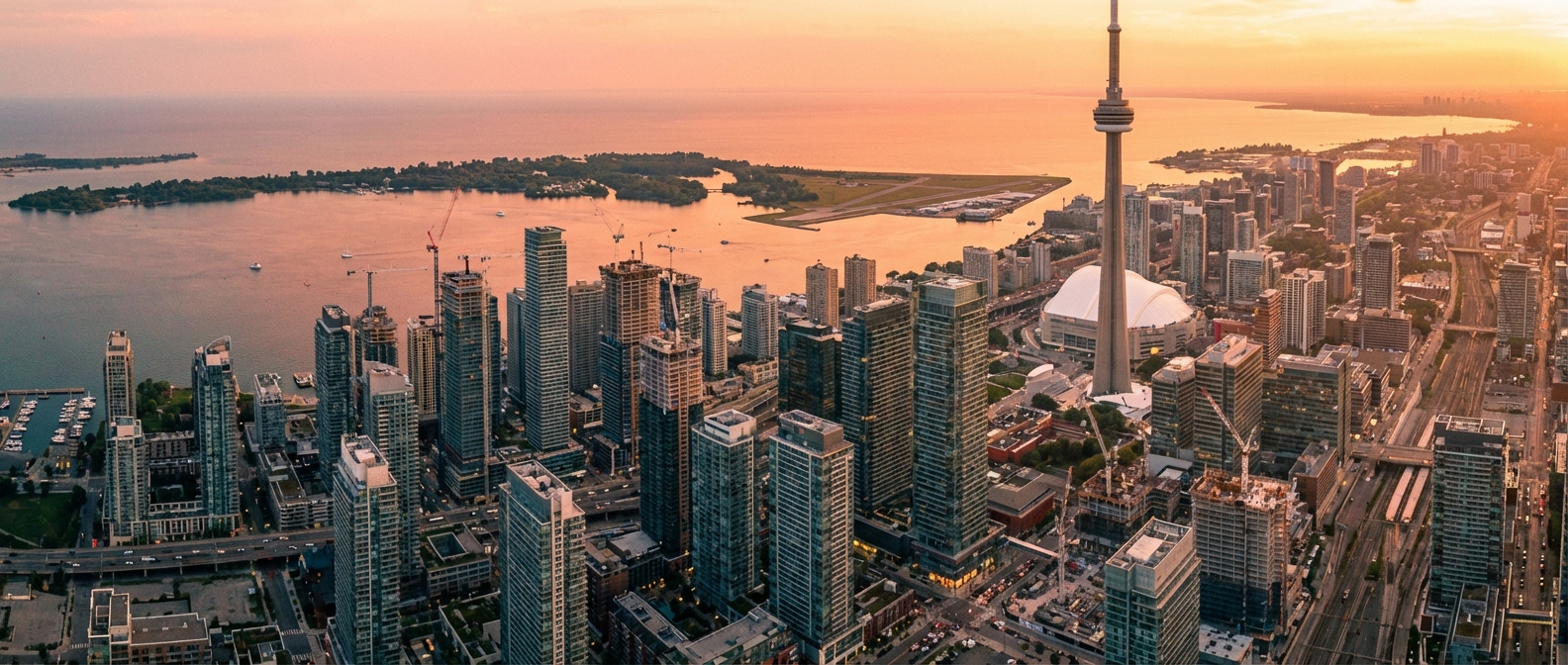
The downtown waterfront corridor — stretching from CityPlace westward toward Liberty Village and eastward toward the Port Lands — remains the epicentre of condo development in Canada. While price per square foot is highest here (averaging $1,100 to $1,350 per square foot for resale units in early 2025), the area benefits from unparalleled transit access, walkability scores above 95, and proximity to over 500,000 jobs within a 5-kilometre radius. Demand here is expected to remain resilient in 2026.
Scarborough and the Eastern Suburbs
Scarborough represents one of the strongest relative-value propositions in the GTA condo market. Average resale condo prices in Scarborough are approximately 12 to 15 percent below the City of Toronto average, yet the area is set to benefit enormously from the Scarborough Subway Extension — a $5.5 billion transit investment currently under construction and targeted for completion in 2030. Pre-construction activity in the Scarborough Town Centre and Kennedy/Lawrence area has accelerated as developers and investors position ahead of the transit announcement's full impact.
Mississauga's City Centre
The transformation of Mississauga's urban core continues to attract both end-users and investors. The Hurontario LRT (now branded as the Hazel McCallion Line), expected to open in 2025, will connect Port Credit to the Brampton Gateway Terminal, substantially improving connectivity for Mississauga condo residents. Projects within walking distance of LRT stations are consistently pricing at a 5 to 8 percent premium over comparable units further from transit, and this trend is expected to intensify in 2026.
Pre-Construction Condos: The Strategic Case for 2026 and Beyond
For buyers with a long-term perspective, pre-construction condos continue to offer a distinctive value proposition — particularly in the current market environment. Here is why the case for pre-construction is strengthening as we approach 2026:
Extended Deposit Structures and Reduced Carrying Costs
Pre-construction condos typically require only 15 to 25 percent of the purchase price in staged deposits over a 12-to-36-month period before a mortgage is required. This means buyers can secure today's price with limited upfront capital, while their funds remain accessible for other investments during the construction period. In a market where prices are expected to appreciate 4 to 6 percent annually from 2026 onward, securing a unit at today's prices represents meaningful future value.
Tarion Warranty Protection
All new condos in Ontario are covered by Tarion Warranty Corporation, which provides statutory warranties on deposits, delayed closing compensation, and construction defects. This layer of consumer protection does not exist in the resale market and provides peace of mind for buyers who are committing capital years before occupancy.
Reduced Competition at Launches
With new project launches at their lowest level since 2010, the projects that do come to market in 2025 and 2026 are attracting careful buyers who recognise the long-term supply gap. Builders who have remained active are generally offering better incentives — including free parking, storage lockers, and capped development charges — to stimulate sales velocity. These incentives compress as market conditions tighten. You can explore current pre-construction opportunities across the GTA on our Discover page.
Risks and Headwinds to Monitor
Any credible market analysis must also acknowledge the risks that could alter the base-case forecast. The following factors have the potential to temper price growth or extend the current period of correction:
| Risk Factor | Potential Impact | Probability (2026 Horizon) |
|---|---|---|
| Renewed inflation / rate hikes | High – would reduce affordability and buyer confidence | Low (15–20%) |
| Sustained investor sell-off | Medium – would increase resale inventory and suppress prices | Moderate (30–35%) |
| Recession / rising unemployment | High – would reduce demand across all price segments | Low-Moderate (20–25%) |
| Further immigration reductions | Medium – would reduce population-driven demand | Moderate (25–30%) |
| Additional government intervention (taxes, levies) | Medium – could dampen investor activity specifically | Low-Moderate (20–25%) |
| US-Canada trade disruption / tariffs | Medium – broader economic uncertainty affects confidence | Moderate (30–40%) |
What the Experts Are Saying
Consensus among major Canadian forecasters points to a moderate recovery in Toronto condo prices through 2026, with the following projections on record as of early 2025:
- TRREB: Projects overall GTA average home price growth of 2.6 percent in 2025, accelerating to 4.0 to 6.0 percent in 2026 as rate cuts fully filter through buyer affordability calculations.
- RBC Economics: Forecasts a "gradual re-acceleration" in Toronto condo activity beginning in late 2025 and strengthening through 2026, driven primarily by first-time buyers and returning investors.
- Urbanation: Notes that the record-low new launch activity of 2024 will create a structural supply deficit by 2027 and 2028, supporting price appreciation for those who enter the market in 2025 and 2026.
- CMHC: Projects that Toronto will require approximately 1.5 million additional housing units by 2030 to restore affordability to long-term norms — a target that current construction rates will not achieve, underpinning long-term demand.
For a broader look at how these forces will affect all GTA housing segments, including detached homes and townhouses, read our in-depth analysis of the GTA real estate market forecast for 2026.
Practical Guidance for Buyers Entering the Toronto Condo Market in 2026
Whether you are purchasing your first home, upgrading, or building an investment portfolio, the following principles will help you navigate the toronto condo market effectively in the year ahead:
- Obtain mortgage pre-approval early. With rate conditions evolving, locking in a rate hold of 90 to 120 days gives you pricing certainty while you search. Most lenders will honour a pre-approval rate even if market rates rise during your search period.
- Focus on transit-oriented locations. Properties within 800 metres of a subway or LRT station consistently outperform the broader condo market over five-to-ten-year periods. Prioritise access to the TTC subway, the Eglinton Crosstown LRT, and the Hazel McCallion Line in your search criteria.
- Understand carrying costs for investment purchases. For investor buyers, ensure that projected rental income covers at least 85 to 90 percent of monthly carrying costs (mortgage, condo fees, property tax) at current rates. The 10 to 15 percent gap can be managed with modest cash reserves while waiting for rents to recover.
- Consider pre-construction for long-term value. With builder incentives available and new launches at decade lows, securing a pre-construction unit in a well-located project offers exposure to an anticipated supply-constrained market in 2027 and beyond.
- Engage a licensed real estate professional. The complexities of assignment clauses, Tarion registrations, occupancy fees, and development charge caps make professional guidance essential for any pre-construction purchase.
Frequently Asked Questions
Will toronto condo prices 2026 be higher or lower than current levels?
Based on the majority of available forecasts from institutions including TRREB, RBC Economics, and Urbanation, toronto condo prices 2026 are expected to be modestly higher than mid-2025 levels — with most analysts projecting appreciation in the range of 3.5 to 6 percent across the GTA. The City of Toronto's 416 area code is forecast to see average condo prices move from approximately $715,000 to $742,000 to $758,000 by end of 2026. However, this recovery will not be uniform: well-located units near transit will outperform those in suburban locations with limited accessibility.
Is 2025 or 2026 a better time to buy a condo in Toronto?
Both years present compelling entry points relative to the 2022 peak. The argument for acting in 2025 is that inventory remains elevated, competition is reduced, and builder incentives are at their most generous. The argument for 2026 is that interest rates should be somewhat lower and more economic certainty will exist. Most financial advisers and real estate professionals with whom we consult suggest that buyers who find a property matching their needs and financial criteria should not attempt to perfectly time the market. The cost of waiting — in terms of continued rent payments and potential appreciation missed — often outweighs the marginal benefit of waiting for a slightly better entry point.
What is the typical price per square foot for a Toronto condo in 2025?
As of early 2025, resale condo apartments in the City of Toronto are trading at approximately $950 to $1,100 per square foot, depending on the neighbourhood, building age, and floor. Downtown core buildings with recent renovations and amenity upgrades trade at the higher end, while older buildings in Etobicoke, Scarborough, and North York can be found in the $800 to $950 range. Pre-construction pricing in recently launched projects ranges from approximately $1,050 to $1,400 per square foot for City of Toronto locations, with suburban GTA projects available from approximately $850 to $1,100 per square foot.
How does the pre-construction condo market differ from the resale market?
Pre-construction condos are purchased directly from the developer before or during construction, with buyers entering into an Agreement of Purchase and Sale and paying staged deposits — typically 5 percent at signing, 5 percent at 90 days, 5 percent at 180 days, and 5 to 10 percent at occupancy. The mortgage is not required until the building registers, which can be two to four years after signing. Resale condos, by contrast, involve a standard real estate transaction with typical 30 to 90 day closing periods and immediate mortgage qualification. Pre-construction offers price certainty, Tarion warranty protection, and the ability to customise finishes, but involves more uncertainty around completion timelines and interim occupancy fees.
What neighbourhoods offer the best value for condo buyers in the GTA heading into 2026?
Based on the combination of relative affordability, infrastructure investment, and employment proximity, the following areas offer compelling value: Scarborough (benefiting from the upcoming Scarborough Subway Extension), Mississauga City Centre (served by the new Hazel McCallion LRT), Etobicoke's Kipling and Islington corridors (Bloor-Danforth subway access at lower price points), and Hamilton's downtown core (for buyers willing to accept commuter distance in exchange for significantly lower entry prices in the $400,000 to $500,000 range). Each of these markets is positioned to benefit from both improving fundamentals and continued population growth in the broader GTHA region.
How do development charges affect pre-construction condo pricing in Toronto?
Development charges (DCs) are levies imposed by municipalities on new residential construction to fund infrastructure such as transit, roads, and community centres. In the City of Toronto, development charges for high-rise residential units have increased substantially in recent years, reaching approximately $46,000 to $62,000 per unit for projects approved after 2023 DC by-law updates. These costs are ultimately passed through to buyers in the form of higher purchase prices, which is one reason why new pre-construction condos are typically priced at a significant premium to resale properties of equivalent specifications. Some builders cap development charge exposure for buyers in their purchase agreements, which represents a meaningful financial benefit worth negotiating for.
What government programs are available to help first-time condo buyers in Toronto in 2026?
First-time buyers in Ontario have access to several meaningful financial assistance programmes heading into 2026. The First Home Savings Account (FHSA) allows eligible buyers to contribute up to $8,000 per year (lifetime maximum $40,000) in tax-deductible contributions that grow tax-free and can be withdrawn tax-free for a qualifying home purchase. The First-Time Home Buyer Incentive has been phased out federally, but the Home Buyers' Plan remains active, permitting RRSP withdrawals of up to $35,000 per person ($70,000 per couple) for a first home purchase, repayable over 15 years. Ontario's Land Transfer Tax rebate for first-time buyers provides a maximum refund of $4,000, and the City of Toronto offers an additional Municipal Land Transfer Tax rebate of up to $4,475. Combined, these programmes can reduce the effective upfront cost of purchasing a Toronto condo by $8,000 to $12,000 for eligible first-time buyers.
Conclusion: A Measured Optimism for the Toronto Condo Market in 2026
The toronto condo market is at an inflection point. The correction of 2022 to 2024 has created genuine value in many segments. The structural forces that have historically driven Toronto condo prices — population growth, constrained land supply, transit investment, and the city's status as Canada's economic capital — remain firmly in place. The interest rate headwinds that suppressed activity are dissipating. And the supply pipeline beyond 2026 is thinning in ways that historically precede meaningful price appreciation.
None of this means that buying a Toronto condo is without risk in 2026. Elevated inventory, investor-driven supply, and ongoing affordability challenges are real constraints that will keep price growth measured rather than explosive. But for buyers with a five-to-ten-year horizon, the current market offers a combination of reduced competition, improved affordability, and long-term supply scarcity that is difficult to ignore.
Whether you are searching for your first home, an investment property, or simply want to understand where the market is headed, condo123.ca provides the tools, data, and listings you need to make an informed decision. Start discovering pre-construction projects across the GTA today and take the first step toward securing your place in one of the world's most dynamic real estate markets.