

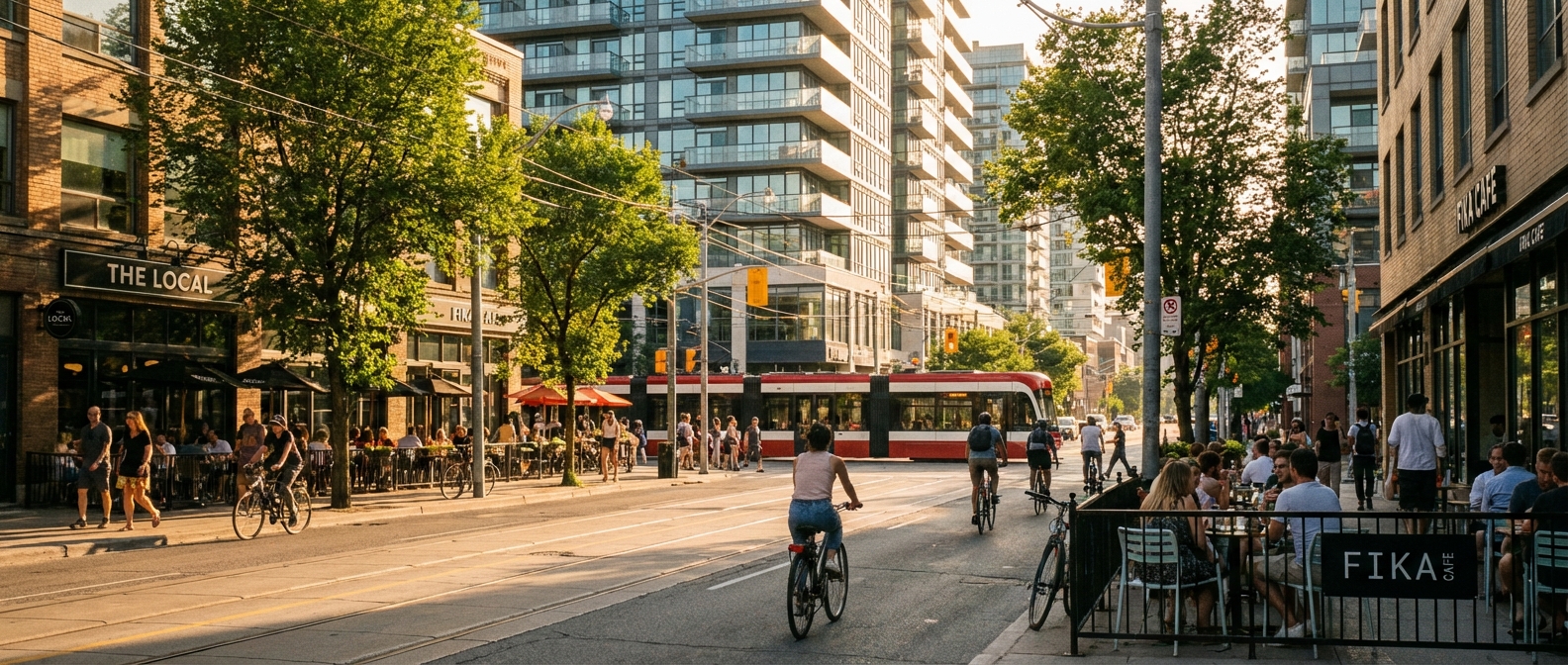
Most Walkable Neighbourhoods in Toronto 2026: Live Car-Free
Condo123 · March 29, 2026
Most Walkable Neighbourhoods in Toronto 2026: The Ultimate Guide to Living Car-Free
Toronto consistently ranks among the most walkable cities in Canada, and for good reason. With an expanding transit network, dense mixed-use development, and neighbourhoods designed around people rather than cars, more Torontonians than ever are ditching their vehicles entirely. In 2026, the average cost of owning a car in Toronto — including insurance, parking, gas, and maintenance — exceeds $12,000 per year. That is money that could go directly toward your mortgage.
Whether you are a first-time buyer searching for a condo in Toronto, a young professional who values convenience over commuting, or a downsizer ready to trade your suburban driveway for a walkable urban lifestyle, choosing the right neighbourhood is everything.
In this guide, we rank and review the 8 most walkable neighbourhoods in Toronto for 2026, complete with Walk Scores, Transit Scores, condo price ranges, lifestyle profiles, and pre-construction activity. We will also explain exactly what makes a neighbourhood "walkable" and how Walk Score works so you can evaluate any area on your own.
What Makes a Neighbourhood Walkable?
Before diving into specific neighbourhoods, it is worth understanding what "walkability" actually means — and how it is measured. A truly walkable neighbourhood is not just one where you can walk. It is one where walking is the easiest, most natural way to accomplish your daily errands, get to work, and enjoy your free time.
How Walk Score Works
Walk Score is the industry-standard metric for measuring neighbourhood walkability. It analyses walking routes to nearby amenities across several categories:
- Grocery stores — Can you walk to buy food?
- Restaurants and cafes — Dining options within walking distance
- Shopping — Retail, pharmacies, and everyday services
- Coffee shops — A proxy for neighbourhood vibrancy
- Banks and financial services
- Parks and green spaces
- Schools and education
- Entertainment and culture
Walk Score assigns a number from 0 to 100 based on the distance to amenities in each category, weighted by importance. The scoring breakdown is as follows:
| Walk Score | Description |
|---|---|
| 90–100 | Walker's Paradise — Daily errands do not require a car |
| 70–89 | Very Walkable — Most errands can be accomplished on foot |
| 50–69 | Somewhat Walkable — Some errands can be accomplished on foot |
| 25–49 | Car-Dependent — Most errands require a car |
| 0–24 | Almost All Errands Require a Car |
Transit Score measures access to public transit based on the distance to the nearest stops, the frequency of service, and the type of transit (subway, streetcar, bus, or commuter rail). Bike Score evaluates cycling infrastructure including bike lanes, hills, road connectivity, and bike commuter mode share.
For this guide, we focus primarily on Walk Score and Transit Score, as these are the two most relevant metrics for buyers looking to live car-free in Toronto.
The 8 Most Walkable Neighbourhoods in Toronto (2026)
Here is a quick comparison before we dive deep into each neighbourhood:
Neighbourhood Comparison Table
| Neighbourhood | Walk Score | Transit Score | Condo Price Range | Best For |
|---|---|---|---|---|
| King West / Entertainment District | ~97 | ~95 | $600K–$1.2M | Young professionals, nightlife lovers |
| St. Lawrence Market / Distillery | ~96 | ~93 | $550K–$950K | History buffs, culture seekers |
| Queen West / Trinity Bellwoods | ~95 | ~92 | $550K–$900K | Creatives, indie culture fans |
| Yorkville / Annex | ~93 | ~94 | $700K–$2M+ | Luxury buyers, academics |
| Yonge & Eglinton | ~92 | ~88 | $500K–$850K | Young couples, transit commuters |
| Liberty Village | ~89 | ~78 | $500K–$800K | Tech workers, entrepreneurs |
| Leslieville / Riverside | ~88 | ~82 | $450K–$750K | Families, east-end value seekers |
| Bloor West Village / Junction | ~85 | ~80 | $500K–$1.2M | Established families, commuters |
Now let us explore each neighbourhood in detail.
1. King West / Entertainment District — Walk Score ~97
King West and the Entertainment District form the undisputed crown jewel of walkable Toronto. Stretching along King Street West from University Avenue to Bathurst Street, this neighbourhood puts virtually everything within a five-minute walk — restaurants, grocery stores, gyms, nightlife, theatres, and offices.
Character and Lifestyle
This is Toronto's most energetic neighbourhood. King West draws a young, affluent crowd that values convenience and social life above all else. The streets are lined with patios in summer, and the restaurant scene is arguably the best in the city. From high-end sushi at Miku to casual brunch spots on Portland Street, you will never run out of dining options. The TIFF Bell Lightbox, Princess of Wales Theatre, and Royal Alexandra Theatre anchor the cultural scene.
For day-to-day living, residents have access to multiple grocery options including Loblaws at Maple Leaf Gardens (a short streetcar ride), Metro, and Rabba Fine Foods. The 504 King streetcar — which benefits from dedicated transit lanes — provides rapid east-west transit, while St. Andrew station on Line 1 is at the neighbourhood's doorstep.
Walk Score and Transit
With a Walk Score of approximately 97 and a Transit Score around 95, King West is a Walker's Paradise by any definition. The dedicated King Street Transit Priority corridor has made the 504 streetcar one of the most reliable surface transit routes in the city. You are also within walking distance of Union Station, giving you access to the GO Transit network for trips beyond the city.
Condo Prices and Pre-Construction
Resale condos in King West range from $600,000 for a studio or junior one-bedroom up to $1.2 million or more for a two-bedroom plus den. The area has seen significant pre-construction activity in recent years, with several new towers in the pipeline along King, Adelaide, and Wellington Streets. Popular developments include high-rise projects from major builders like Concord, Tridel, and Great Gulf.
If you are considering pre-construction options in this area, browse Toronto pre-construction condos on Condo123 to compare projects, pricing, and floor plans.
Who Should Live Here
King West is ideal for young professionals aged 25 to 40 who work in finance, tech, or media; couples without children who prioritise nightlife and dining; and anyone whose office is in the Financial District or along the King streetcar route. If you value quiet evenings and green space, this may not be the right fit — the neighbourhood is lively and can be loud on weekends.
2. St. Lawrence Market / Distillery District — Walk Score ~96
Just east of the Financial District, the St. Lawrence Market and Distillery District area offers one of the most unique living experiences in Toronto. This neighbourhood pairs historic architecture with modern condo living, delivering exceptional walkability with a character you simply will not find anywhere else in the city.
Character and Lifestyle
The St. Lawrence Market — voted the world's best food market by National Geographic — is the beating heart of this neighbourhood. On Saturday mornings, the market is packed with vendors selling fresh produce, artisanal cheeses, peameal bacon sandwiches, and locally roasted coffee. The Distillery District, a pedestrian-only heritage precinct of Victorian-era industrial buildings, is home to galleries, restaurants, breweries, and seasonal events including the beloved Toronto Christmas Market.
The neighbourhood also benefits from direct access to the waterfront trail system, Sugar Beach, and the developing East Bayfront area. The Corktown Common park provides green space, playgrounds, and stunning views of the city skyline.
Walk Score and Transit
With a Walk Score of approximately 96 and a Transit Score around 93, this neighbourhood is a true Walker's Paradise. King Station and Union Station are both accessible on foot, and the 504 King streetcar runs directly through the area. The planned Ontario Line will add a new station at Corktown, further improving transit connectivity.
Condo Prices and Pre-Construction
Resale condos range from $550,000 for a one-bedroom to $950,000 for a larger two-bedroom unit. The Distillery District itself has several well-regarded condo buildings, and the broader area — including the West Don Lands and East Bayfront — has been a hotbed of pre-construction activity. Developments here tend to be mid-rise or boutique in scale, which appeals to buyers who prefer a less tower-dominated streetscape.
Who Should Live Here
This neighbourhood suits culture enthusiasts, foodies, and buyers who appreciate heritage character. It is also excellent for professionals who work downtown and want a slightly quieter, more refined alternative to King West. Proximity to the waterfront makes it appealing to runners, cyclists, and anyone who values outdoor recreation.
3. Queen West / Trinity Bellwoods — Walk Score ~95
Queen West has been called "one of the coolest neighbourhoods in the world" by Vogue magazine, and it lives up to the hype. Centred around Trinity Bellwoods Park, this neighbourhood is the creative heart of Toronto — a place where indie boutiques, vintage shops, art galleries, and third-wave coffee roasters define the streetscape.
Character and Lifestyle
Trinity Bellwoods Park is the social anchor. On any summer weekend, the park is a sea of picnic blankets, frisbee games, and people watching. The surrounding streets — Queen, Dundas, Ossington, and College — are packed with independent restaurants, bars, and shops that give the neighbourhood its distinctive personality. This is not chain-store territory. Queen West rewards exploration, and you will discover a new favourite spot every month.
Grocery options include a Fresh Co on Gladstone, a No Frills on Dufferin, and numerous specialty food shops along Queen and Dundas. The neighbourhood is also home to some of Toronto's best bakeries, including the legendary Nadege Patisserie.
Walk Score and Transit
A Walk Score of approximately 95 and a Transit Score around 92 make Queen West one of the most walkable neighbourhoods in the city. The 501 Queen streetcar provides reliable east-west transit, and Ossington station on Line 2 is a short walk north. Multiple bus routes connect the neighbourhood to other parts of the city.
Condo Prices and Pre-Construction
Condos in Queen West and the Trinity Bellwoods area range from $550,000 for a one-bedroom to $900,000 for a two-bedroom. The building stock here is more varied than in the downtown core — you will find low-rise loft conversions, boutique mid-rises, and some taller towers along Queen Street. Pre-construction activity has been moderate, with a few notable projects adding modern supply to the neighbourhood.
Who Should Live Here
Queen West is perfect for creatives, freelancers, and anyone who values individuality and community over polish and prestige. It suits buyers who want walkability without the corporate downtown feel — people who would rather grab a flat white at a neighbourhood roastery than a Starbucks in a tower lobby. The park-centric lifestyle also makes it surprisingly appealing for young families.
4. Yorkville / Annex — Walk Score ~93
Yorkville and the Annex represent two sides of the same coin — luxury meets academic village, all wrapped in exceptional walkability. Yorkville is Toronto's answer to Fifth Avenue or Bond Street, while the Annex is a tree-lined, intellectually vibrant neighbourhood anchored by the University of Toronto.
Character and Lifestyle
Yorkville is where you will find Toronto's most exclusive shopping — Chanel, Hermes, Tiffany, and Louis Vuitton all have flagships here. The restaurant scene skews upscale, with spots like Sassafraz, STK, and the rooftop bar at the Yorkville Royal Sonesta drawing a well-heeled crowd. The Royal Ontario Museum and the Gardiner Museum add cultural depth.
Step a few blocks west into the Annex and the vibe shifts dramatically. Victorian homes line tree-canopied streets. Bloor Street is packed with bookshops, pubs, ethnic restaurants, and the Bloor Hot Docs Cinema. It is intellectual, relaxed, and deeply walkable. The Annex has long been one of Toronto's most desirable neighbourhoods for professors, writers, and professionals who value character over flash.
Walk Score and Transit
With a combined Walk Score of approximately 93 and a Transit Score around 94, this area is exceptionally well-connected. Bay, Bloor-Yonge, Museum, St. George, and Spadina stations all serve the neighbourhood, making it one of the best-connected areas in Toronto by subway. The Bloor-Danforth line (Line 2) and Yonge-University line (Line 1) intersect here.
Condo Prices and Pre-Construction
Prices vary significantly between Yorkville and the Annex. In Yorkville, luxury condos range from $700,000 for a compact one-bedroom to well over $2 million for a premium two-bedroom or penthouse. Developments like the One Bloor and 1 Yorkville have set new benchmarks for price per square foot. In the Annex, options are somewhat more limited but condos can be found in the $600,000 to $1 million range.
Pre-construction in Yorkville continues to attract premium buyers. If you are interested in luxury pre-construction projects, explore new developments on Condo123.
Who Should Live Here
Yorkville suits luxury buyers, empty nesters, and international buyers who want a prestigious address. The Annex appeals to University of Toronto faculty and staff, professionals who value intellectual community, and families who want access to top-rated schools in a walkable setting. Both areas work well for anyone who relies on subway commuting.
5. Liberty Village — Walk Score ~89
Liberty Village is a modern, self-contained neighbourhood built within a former industrial area between King Street West and the Gardiner Expressway. It has become one of Toronto's most popular neighbourhoods for tech workers, entrepreneurs, and young professionals — but it comes with one notable caveat: transit access.
Character and Lifestyle
Liberty Village feels like a small town within the city. The neighbourhood is densely developed with condos, but it also has a strong sense of community. Liberty Village Park serves as the central gathering spot, and the streets are lined with cafes, restaurants, co-working spaces, and fitness studios. Many of Toronto's tech startups and creative agencies are headquartered here, which means the neighbourhood has a work-live energy that feels distinctly modern.
Grocery shopping is well-covered with a Loblaws and several convenience stores. The neighbourhood also has its own dog park, a YMCA, and a growing roster of independent shops.
Walk Score and Transit
Liberty Village scores approximately 89 for walkability, placing it firmly in the "Very Walkable" category. Internally, everything you need is within a short walk. However, its Transit Score of around 78 reflects a real limitation: there is no subway station in Liberty Village. The neighbourhood relies on the 504 King streetcar and the 63 Ossington bus for transit connections. The Exhibition GO station is nearby but serves limited routes. This transit gap is the single biggest drawback and is something buyers should carefully consider.
Condo Prices and Pre-Construction
Liberty Village offers some of the best value among walkable Toronto neighbourhoods, with resale condos ranging from $500,000 for a one-bedroom to $800,000 for a two-bedroom. The neighbourhood features a mix of newer glass towers and converted loft-style buildings from the area's industrial heritage. Pre-construction activity remains strong, with several projects in the approval pipeline.
Who Should Live Here
Liberty Village is ideal for tech workers, remote workers, and entrepreneurs who spend a lot of their time within the neighbourhood itself. If your commute requires a subway transfer, the limited transit could become frustrating. It is also a great fit for dog owners thanks to the park infrastructure and a strong pet-friendly culture.
6. Yonge and Eglinton — Walk Score ~92
Known affectionately as "Young and Eligible," the Yonge and Eglinton area has long been one of Toronto's most popular neighbourhoods for young professionals and couples. In 2026, the completion of the Eglinton Crosstown LRT is set to further transform this already walkable midtown hub.
Character and Lifestyle
Yonge and Eglinton strikes a balance that is hard to find elsewhere in Toronto. It has the density and amenity access of a downtown neighbourhood, but with a slightly more relaxed, residential feel. The intersection itself is a commercial hub with restaurants, bars, and shops stretching in every direction. Mount Pleasant Cemetery and Eglinton Park provide green space, while the surrounding residential streets are lined with mature trees.
The Yonge-Eglinton Centre and surrounding retail provide ample shopping and dining. Grocery options include a Metro, Whole Foods, and several smaller markets. The neighbourhood also has an excellent selection of gyms, yoga studios, and wellness centres.
Walk Score and Transit
A Walk Score of approximately 92 puts Yonge and Eglinton solidly in Walker's Paradise territory. The Transit Score of around 88 is strong and is poised to improve significantly with the Eglinton Crosstown LRT. Currently, Eglinton station on Line 1 provides direct subway access to downtown in under 15 minutes. Once the Crosstown is fully operational, east-west transit across the city will be dramatically improved, making this neighbourhood even more connected.
Condo Prices and Pre-Construction
Condos at Yonge and Eglinton range from $500,000 for a one-bedroom to $850,000 for a two-bedroom. The area has seen a boom in condo construction, with numerous towers completed in recent years and more on the way. Prices here represent solid value compared to downtown, especially given the transit improvements. Pre-construction activity is robust, and projects near future LRT stops are particularly worth watching.
Who Should Live Here
Yonge and Eglinton is perfect for young couples, professionals who commute downtown via subway, and buyers who want a vibrant neighbourhood without the intensity of the downtown core. The strong rental market also makes it attractive for investors. If you are weighing the rent-versus-buy decision, our Rent vs. Buy Toronto 2026 guide can help you run the numbers.
7. Leslieville / Riverside — Walk Score ~88
Leslieville and the adjacent Riverside neighbourhood represent the east end's best bet for walkable, family-friendly living at prices that are noticeably more affordable than downtown. Over the past decade, this stretch of Queen Street East has transformed from a quiet, overlooked area into one of Toronto's most desirable neighbourhoods.
Character and Lifestyle
Leslieville has a village-within-the-city feel. Queen Street East is the main artery, lined with independent coffee shops like Te Aro, brunch institutions like Lady Marmalade, and a growing number of quality restaurants. The neighbourhood is particularly popular with young families — you will see strollers everywhere on weekends. Greenwood Park, Jonathan Ashbridge Park, and easy access to the waterfront trail system provide ample outdoor space.
The vibe is unpretentious and community-oriented. Neighbours know each other. Local businesses thrive. It is the kind of neighbourhood where you develop a "regular" coffee order at your local cafe within weeks of moving in.
Walk Score and Transit
Leslieville's Walk Score of approximately 88 places it in the "Very Walkable" category. The Transit Score of around 82 reflects good — though not exceptional — transit access. The 501 Queen streetcar runs through the neighbourhood, and the Broadview and Chester stations on Line 2 are accessible from the northern edge. Future transit improvements, including potential connections to the Ontario Line at East Harbour, could significantly boost connectivity.
Condo Prices and Pre-Construction
This is where the east end's value proposition becomes clear. Condos in Leslieville and Riverside range from $450,000 for a one-bedroom to $750,000 for a two-bedroom — substantially less than comparable units in King West or Yorkville. The building stock includes converted warehouses, low-rise boutique buildings, and newer mid-rise developments along Queen Street East. Pre-construction activity in the broader east end, particularly around the East Harbour development, promises to bring new supply and improved infrastructure.
Who Should Live Here
Leslieville is ideal for young families, first-time buyers on a budget, and anyone who values community character over downtown flash. It is also an excellent neighbourhood for those who enjoy cycling, as the waterfront trail and dedicated bike lanes make car-free commuting entirely practical. For first-time buyers specifically, our First-Time Home Buyer Guide walks through everything from down payments to closing costs.
8. Bloor West Village / Junction — Walk Score ~85
Rounding out our list, Bloor West Village and the Junction offer a distinctly different flavour of walkability — one rooted in established neighbourhoods, mature streetscapes, and a mix of housing types that includes both condos and houses. These west-end neighbourhoods prove that walkability is not exclusively a downtown phenomenon.
Character and Lifestyle
Bloor West Village is one of Toronto's original "village" shopping districts. The stretch of Bloor Street between Jane and Runnymede is lined with independent shops, restaurants, bakeries, and services that have served the community for decades. It has a distinctly European feel, with strong Ukrainian, Polish, and Lithuanian communities contributing to the neighbourhood's cultural fabric and food scene.
The Junction, centred on Dundas Street West near Keele, has emerged as one of Toronto's most exciting neighbourhood transformations. Once a dry neighbourhood (alcohol sales were banned until 1998), it is now home to craft breweries, trendy restaurants, vintage shops, and a thriving arts scene. The Junction Flea Market and the Stockyards shopping area add to the retail mix.
High Park — one of Toronto's largest and most beautiful green spaces — sits between these two neighbourhoods, offering 160 hectares of trails, gardens, a zoo, and seasonal activities.
Walk Score and Transit
With a Walk Score of approximately 85, these neighbourhoods are "Very Walkable" with strong local amenity access. The Transit Score of around 80 reflects decent connectivity: the Bloor-Danforth subway line (Line 2) runs through the area with stations at Dundas West, Keele, High Park, Runnymede, and Jane. The UP Express at Bloor-Dundas West station provides a direct connection to Pearson Airport in roughly 20 minutes — a major advantage for frequent travellers.
Condo Prices and Pre-Construction
The housing mix here is broader than in most of the other neighbourhoods on this list. Condos range from $500,000 for a one-bedroom to upwards of $1.2 million for larger units or townhouse-style condos. Semi-detached houses and townhomes are also available, offering more space for families. Pre-construction activity in the Junction has been picking up, with several mid-rise projects adding modern units to the neighbourhood.
Who Should Live Here
Bloor West Village and the Junction suit established families, couples planning to start families, and buyers who want walkability paired with more space and a lower-key lifestyle. The UP Express access is a genuine differentiator for anyone who travels frequently for work. These neighbourhoods also appeal to buyers who want the option of a house or townhome rather than a condo tower.
How to Choose the Right Walkable Neighbourhood for You
With eight strong options, choosing the right walkable neighbourhood comes down to understanding your own priorities. Here are the key factors to weigh:
Budget
If affordability is your primary concern, Leslieville offers the lowest entry point for condos, followed by Liberty Village and Yonge and Eglinton. If budget is not a constraint, Yorkville delivers the most prestigious address. For a detailed breakdown of what to expect at closing, see our GTA Real Estate Market Forecast for 2026.
Transit Dependence
If you rely heavily on the subway for your daily commute, prioritise neighbourhoods with direct subway access: Yorkville / Annex, King West, Yonge and Eglinton, and Bloor West Village / Junction all have excellent subway connectivity. Liberty Village is the weakest on this front, as it has no subway station.
Lifestyle and Life Stage
Young professionals and social butterflies will gravitate toward King West and Queen West. Families should look closely at Leslieville and Bloor West Village. Culture and food enthusiasts will love St. Lawrence Market / Distillery. Tech workers and entrepreneurs will find their tribe in Liberty Village.
Future Appreciation
Neighbourhoods with upcoming transit improvements tend to see the strongest price appreciation. In 2026, Yonge and Eglinton (Eglinton Crosstown LRT), St. Lawrence Market / Distillery (Ontario Line at Corktown), and Leslieville (East Harbour development) are all poised to benefit from infrastructure investment. For a broader look at where the market is heading, our GTA Real Estate Market Forecast 2026 covers trends across the Greater Toronto Area.
The Financial Case for Walkability
Choosing a walkable neighbourhood is not just a lifestyle decision — it is a financial one. Here is how the numbers break down when you eliminate car ownership in Toronto:
| Annual Car Ownership Cost | Estimated Amount |
|---|---|
| Car insurance (Toronto average) | $2,400–$3,600 |
| Monthly parking (downtown) | $2,400–$4,800 |
| Gas / EV charging | $1,800–$2,400 |
| Maintenance and repairs | $1,200–$2,000 |
| Car payment (if financing) | $4,000–$7,200 |
| Total | $11,800–$20,000 |
Even at the conservative end, you are looking at nearly $12,000 per year — or $1,000 per month — that could be redirected toward your mortgage. Over a 25-year amortisation period, that additional $1,000 per month toward your mortgage could save you over $100,000 in interest and allow you to pay off your home years ahead of schedule.
Meanwhile, a TTC monthly pass costs $156 in 2026, and a bike costs nothing to operate after the initial purchase. The financial math overwhelmingly favours walkable living for those who can make it work.
Tips for Living Car-Free in Toronto
Making the transition to car-free living is easier in Toronto than in most North American cities, but it does require some adjustment. Here are practical tips from Torontonians who have made it work:
- Get a TTC Metropass equivalent (PRESTO pass). At $156 per month for unlimited rides, it is the foundation of your car-free life. Load it on your PRESTO card and you will never worry about single fares again.
- Use a car-share service for the occasional trip. Zipcar, Communauto, and Enterprise CarShare all operate in Toronto. For those once-a-month IKEA runs or weekend cottage trips, you can rent a car by the hour without the overhead of ownership.
- Invest in a quality bike. Toronto's cycling infrastructure has improved dramatically, with expanded bike lanes on Bloor, Richmond, Adelaide, and many other streets. An e-bike can extend your comfortable range significantly.
- Use grocery delivery for heavy loads. Services like Instacart, PC Express, and Uber Eats grocery delivery mean you do not need a car to do a large weekly shop.
- Choose your neighbourhood wisely. As this guide illustrates, not all walkable neighbourhoods are equal when it comes to transit. If you know you will need transit for your commute, prioritise Walk Score and Transit Score equally.
Pre-Construction Opportunities in Walkable Neighbourhoods
For buyers who are willing to wait for occupancy, pre-construction condos in Toronto's walkable neighbourhoods can offer several advantages: lower purchase prices compared to resale (in some cases), the ability to customise finishes, extended deposit structures that allow you to save gradually, and potential for appreciation during the building period.
In 2026, several high-profile pre-construction projects are launching in the neighbourhoods featured in this guide. Whether you are looking at a boutique mid-rise in the Distillery District, a sleek tower in King West, or a family-sized unit in the Junction, pre-construction can be a smart path to ownership in an otherwise competitive market.
Browse all Toronto pre-construction condos on Condo123 to compare projects, floor plans, pricing, and estimated occupancy dates.
Frequently Asked Questions
What is the most walkable neighbourhood in Toronto?
King West and the Entertainment District hold the highest Walk Score in Toronto at approximately 97 out of 100, making it a Walker's Paradise where daily errands do not require a car. St. Lawrence Market and the Distillery District follow closely with a score of around 96. Both neighbourhoods offer exceptional access to grocery stores, restaurants, transit, entertainment, and employment centres within walking distance.
Can you live in Toronto without a car?
Yes, living car-free in Toronto is entirely practical if you choose the right neighbourhood. The TTC subway, streetcar, and bus network covers much of the city, and walkable neighbourhoods like those featured in this guide provide all essential amenities within walking distance. The average Torontonian who eliminates car ownership saves between $12,000 and $20,000 per year, which can be redirected toward housing costs. Car-share services like Zipcar and Communauto fill the gap for occasional trips that require a vehicle.
What is a good Walk Score for buying a condo in Toronto?
A Walk Score of 70 or above is considered "Very Walkable," meaning most errands can be accomplished on foot. For a truly car-free lifestyle, aim for a Walk Score of 90 or higher, which is classified as a "Walker's Paradise." All eight neighbourhoods in this guide score 85 or above, and the top five score above 90. When evaluating a specific condo listing, check both Walk Score and Transit Score, as a high Walk Score with a low Transit Score (like Liberty Village) may still require a car for commuting.
Which walkable Toronto neighbourhood is most affordable for first-time buyers?
Leslieville and Riverside offer the most affordable entry point among Toronto's walkable neighbourhoods, with one-bedroom condos starting around $450,000 and two-bedrooms available under $750,000. Liberty Village and Yonge and Eglinton are also strong value options with one-bedrooms starting around $500,000. First-time buyers should also explore government programs like the First Home Savings Account and land transfer tax rebates, which can save thousands — see our First-Time Home Buyer Guide for a complete breakdown.
How will the Eglinton Crosstown LRT affect Toronto walkability?
The Eglinton Crosstown LRT is one of the most significant transit infrastructure projects in Toronto's history. Running 19 kilometres along Eglinton Avenue from Mount Dennis to Kennedy Station, it will add 25 stations and stops to the transit network. For the Yonge and Eglinton neighbourhood specifically, the Crosstown will dramatically improve east-west connectivity, which has historically been limited to bus routes. Properties near Crosstown stations are expected to see above-average appreciation as the line reaches full operation in 2026.
Is Liberty Village a good place to buy a condo in 2026?
Liberty Village offers strong walkability (Walk Score ~89) and some of the best condo value in central Toronto, with prices ranging from $500,000 to $800,000. It is an excellent choice for tech workers, remote workers, and entrepreneurs who spend most of their time within the neighbourhood. However, the lack of a subway station is a real limitation. If your daily commute requires reliable rapid transit, you may find the streetcar-dependent connections frustrating during peak hours. Weigh this trade-off carefully against the price advantage and lifestyle benefits.
What Toronto neighbourhoods are best for families who want to live car-free?
Leslieville and Bloor West Village / the Junction are the top picks for families seeking walkable, car-free living. Leslieville offers a village-like community feel, excellent parks, waterfront access, and family-friendly restaurants at the most affordable price point on this list. Bloor West Village and the Junction provide access to High Park (one of Toronto's largest green spaces), strong schools, a mix of housing types including townhomes, and direct subway access on Line 2. Both neighbourhoods have a mature, community-oriented character that families tend to appreciate more than the high-energy downtown alternatives.
Final Thoughts: Your Walkable Toronto Awaits
Toronto's walkable neighbourhoods are not just pleasant places to live — they represent a fundamentally smarter way to approach homeownership in an expensive city. By eliminating car costs, reducing commute times, and investing in a neighbourhood where everything you need is at your doorstep, you are making a decision that pays dividends in both quality of life and financial health.
The eight neighbourhoods in this guide each offer a distinct version of walkable living, from the high-energy nightlife of King West to the family-friendly charm of Leslieville to the heritage character of the Distillery District. The right choice depends on your budget, your lifestyle, and your priorities.
Ready to find your walkable Toronto condo? Start exploring listings on Condo123 and filter by neighbourhood, price range, and building features to find your perfect match. Whether you are buying your first home, upgrading, or investing, the most walkable neighbourhoods in Toronto offer some of the strongest long-term value in Canadian real estate.