

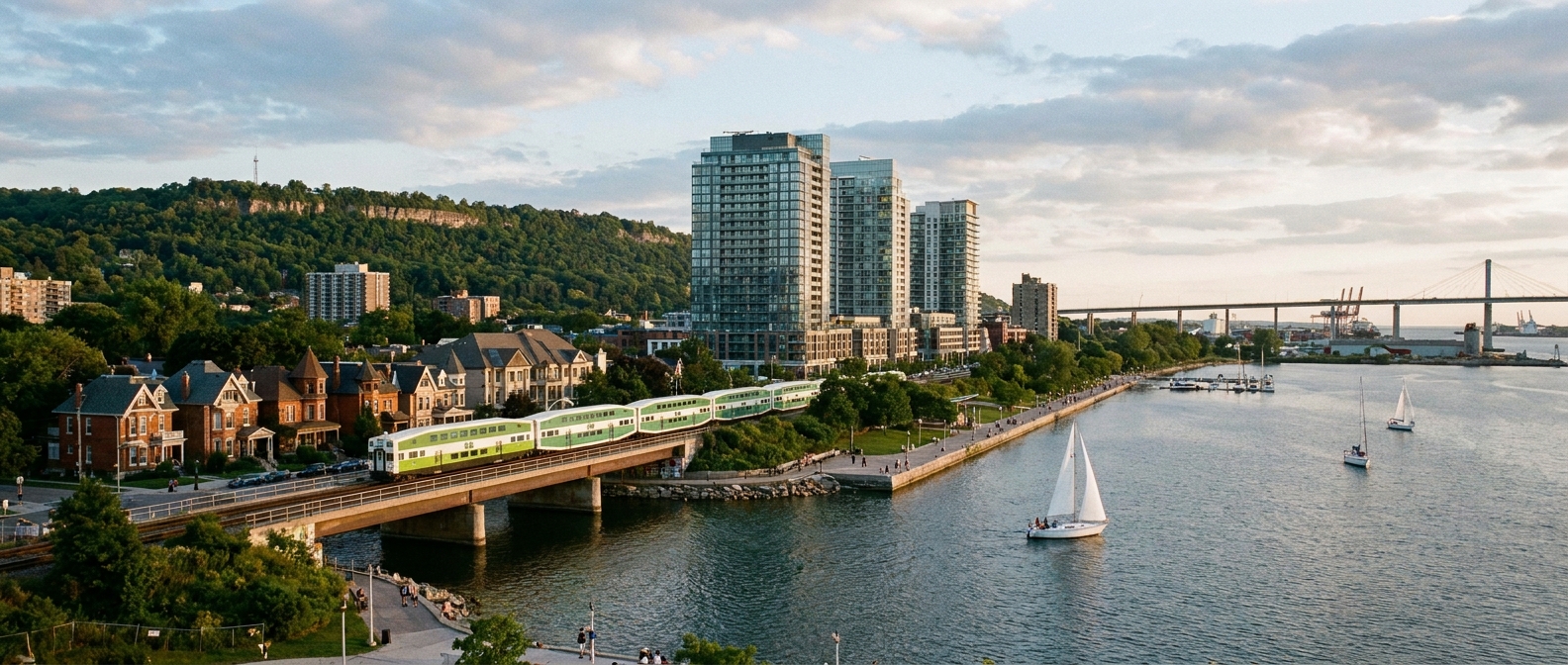
Hamilton Real Estate Guide 2026: The Affordable GTA Alternative
Condo123 · April 23, 2026
Hamilton Real Estate Guide 2026: The Affordable GTA Alternative
For GTA homebuyers who feel priced out of Toronto's relentless property market, Hamilton has emerged as one of the most compelling real estate destinations in Ontario. Sitting just 68 kilometres southwest of downtown Toronto along the western tip of Lake Ontario, Hamilton offers a rare combination of affordability, cultural vibrancy, and infrastructure investment that is attracting first-time buyers, seasoned investors, and urban transplants in growing numbers. This comprehensive guide to the Hamilton real estate market in 2026 will walk you through everything you need to know before making one of the most significant financial decisions of your life.
Whether you are weighing up the Hamilton vs Toronto real estate question for the first time or you have been tracking the Hamilton housing market for several years, the data and insights in this guide will give you a sharper, more informed perspective. You can also explore current pre-construction opportunities across Ontario on our Discover page to see how Hamilton stacks up against other high-growth markets.
Why Hamilton Is Having Its Moment in 2026
Hamilton's transformation from a post-industrial steel city into a dynamic urban centre has been underway for over a decade, but the momentum in 2026 is unlike anything the city has seen before. Several converging forces have elevated Hamilton's profile among serious property buyers:
- The LRT effect: The long-awaited Hamilton Light Rail Transit project along the King Street corridor has re-energised developer confidence and residential demand. The LRT, which broke ground in 2024, is projected to deliver 14 kilometres of rapid transit connecting McMaster University to Queenston Traffic Circle.
- Remote and hybrid work permanence: With Statistics Canada reporting that approximately 22 percent of Canadian workers still operate under hybrid arrangements as of late 2025, the calculus of commuting distance has fundamentally changed. Hamilton is comfortably reachable from Toronto via GO Transit in under 60 minutes.
- Post-secondary anchor institutions: McMaster University, ranked among Canada's top five research universities, and Mohawk College together enrol over 50,000 students annually, creating sustained rental demand and a talent pipeline that attracts employers.
- Population growth targets: Hamilton's official plan identifies a growth target of 236,000 new residents by 2051, requiring an additional 75,000 housing units. That scale of planned development underpins long-term property value appreciation.
Hamilton Housing Market Overview: Key Statistics for 2026
Understanding the raw numbers is essential before drawing any conclusions about value or timing. The table below summarises the most relevant benchmarks across Hamilton's housing categories as of early 2026, compared with Greater Toronto Area figures for context.
| Property Type | Hamilton Benchmark Price (2026) | GTA Benchmark Price (2026) | Hamilton Discount |
|---|---|---|---|
| Detached Home | $849,000 | $1,412,000 | ~40% |
| Semi-Detached | $671,000 | $1,054,000 | ~36% |
| Townhouse | $588,000 | $901,000 | ~35% |
| Condominium Apartment | $489,000 | $698,000 | ~30% |
These figures draw from regional real estate board data and represent benchmark prices, which smooth out outliers to reflect the typical property in each category. The discount Hamilton offers relative to the GTA is substantial across every property type, and it is particularly pronounced in the detached segment — the category most out of reach for first-time buyers in Toronto.
Average days on market in Hamilton hovered around 28 days in early 2026, compared to 22 days in the GTA core. This slight difference indicates a market that remains competitive but gives buyers marginally more breathing room to conduct due diligence — a material advantage for anyone navigating their first purchase.
Hamilton vs Toronto Real Estate: A Side-by-Side Analysis
The Hamilton vs Toronto real estate debate is rarely a simple affordability calculation. It involves lifestyle trade-offs, commuting considerations, income proximity, and long-term investment thesis. Here is a structured comparison across the dimensions that matter most to GTA buyers.
Purchase Price and Mortgage Carrying Costs
Using a typical detached home as the reference point, a Hamilton buyer at $849,000 with a 20 percent down payment ($169,800) and a five-year fixed mortgage rate of 4.49 percent over a 25-year amortisation period would carry a monthly mortgage payment of approximately $3,740. The equivalent Toronto buyer at $1,412,000 with the same down payment ratio ($282,400) would face a monthly payment of approximately $6,230. That is a difference of $2,490 per month — or $29,880 per year — that a Hamilton buyer could redirect toward savings, lifestyle, or additional investment.
Commuting Reality
GO Transit's Lakeshore West line connects Hamilton's West Harbour GO station to Toronto Union Station with a peak-hour journey of approximately 57 minutes. For buyers who commute two or three days per week under hybrid arrangements, this is an entirely manageable journey. Monthly GO Transit passes from Hamilton to Toronto are priced at approximately $395 as of 2026, representing a meaningful but often justified additional cost when set against the mortgage savings outlined above.
Rental Income Potential
Hamilton's rental market has tightened considerably over the past three years. The Canada Mortgage and Housing Corporation (CMHC) reported a rental vacancy rate of 2.1 percent for Hamilton in its 2025 Housing Market Outlook, signalling a landlord-favourable environment. Average rent for a two-bedroom apartment in Hamilton sits at approximately $2,050 per month, compared to $2,740 in Toronto. While the absolute rent is lower, the yield on a Hamilton investment property is often superior given the lower acquisition cost.
Appreciation Trajectory
Over the ten-year period from 2015 to 2025, Hamilton residential property values appreciated by approximately 118 percent, compared to 94 percent in the City of Toronto proper over the same period. Hamilton's stronger appreciation reflects a city playing catch-up from a lower base while also benefiting from spill-over demand from the GTA. While past performance is not a guarantee of future results, the structural drivers of Hamilton's growth remain intact.
| Factor | Hamilton | Toronto | Winner |
|---|---|---|---|
| Entry Price Point | Lower by 30–40% | Higher | Hamilton |
| Gross Rental Yield | ~4.8% | ~3.9% | Hamilton |
| 10-Year Appreciation | ~118% | ~94% | Hamilton |
| Downtown Amenities | Growing | World-class | Toronto |
| Commute to Toronto Core | 57 min (GO Train) | N/A | Toronto |
| Development Pipeline | Very Active | Active | Hamilton |
| Property Tax Rate | ~1.30% (2025) | ~0.63% (2025) | Toronto |
It is worth noting that Hamilton's higher property tax rate does partially offset the purchase price advantage, particularly for buyers in higher price brackets. A $849,000 Hamilton home generates an annual property tax bill of approximately $11,037, while a $1,412,000 Toronto home at the lower rate generates approximately $8,896. Buyers should factor this into their total cost of ownership calculations.
Hamilton's Most Promising Neighbourhoods in 2026
Not all of Hamilton's neighbourhoods present equal opportunity. Understanding where the city is investing, where density is being encouraged, and where lifestyle infrastructure is maturing will help buyers identify the best value propositions for their specific goals.
Barton Village and Gibson
Located in Hamilton's lower city east end, Barton Village has undergone significant revitalisation over the past five years. Independent restaurants, craft breweries, and gallery spaces have colonised formerly vacant storefronts along Barton Street East, drawing comparisons to Dundas West in Toronto before that neighbourhood's prices stratified. Detached homes in Gibson and Barton Village still trade in the $550,000 to $750,000 range, representing some of the strongest value-per-square-foot propositions in the entire city. The neighbourhood sits within the LRT catchment area, which will further accelerate commercial and residential investment.
James Street North and the Art Crawl District
Hamilton's art scene has a national profile, and James Street North is its beating heart. The monthly Art Crawl event regularly draws thousands of visitors and has cemented the street as a cultural destination. Loft conversions, boutique condominiums, and heritage renovations have transformed the building stock, and new pre-construction towers along the corridor are offering investors ground-floor entry into what many analysts consider Hamilton's equivalent of Toronto's King West. Condominium prices here range from $479,000 to $649,000 for one and two-bedroom units.
Waterdown
For buyers prioritising family-oriented suburban living with excellent school ratings and natural amenity access, Waterdown delivers. Situated in the northern part of Hamilton's amalgamated municipality, Waterdown features new master-planned communities, proximity to the Bruce Trail, and a small-town character that resonates strongly with Toronto escapees. Detached homes range from $875,000 to $1,150,000, reflecting a premium for the lifestyle offering. Waterdown has its own GO bus connections and is positioned for significant development under Hamilton's growth plan.
Stoney Creek
Stoney Creek, on Hamilton's eastern boundary adjacent to the Niagara Escarpment, has long been favoured for its natural setting and lakefront access. The area is experiencing renewed interest from developers, with several new townhouse and low-rise condominium projects targeting the $549,000 to $749,000 range. Stoney Creek also benefits from direct highway access to the QEW, making it a practical choice for buyers who commute by car to Burlington, Oakville, or Mississauga rather than Toronto.
Dundas
Often described as a hidden gem within Hamilton's borders, Dundas is a walkable, heritage-rich community nestled at the base of the Niagara Escarpment. The village atmosphere, farmers' market, and trail network attract a demographic willing to pay a modest premium. Average detached prices in Dundas sit at approximately $920,000, reflecting its reputation as one of the most liveable communities in the Hamilton area. For buyers interested in the broader regional picture, our guide to up-and-coming GTA areas in 2026 provides useful comparative context for Dundas and similar communities.
Pre-Construction Opportunities in Hamilton
Hamilton's pre-construction market has matured considerably since the speculative peak of 2021 and 2022. Developers who pulled back during the correction period have re-entered with more disciplined pricing and better-calibrated unit mixes that reflect genuine end-user demand rather than investor speculation. This creates a more stable and arguably more attractive buying environment for 2026 purchasers.
Current pre-construction projects in Hamilton span multiple typologies:
- High-rise condominiums along the King Street LRT corridor, with suite prices ranging from $459,000 for studios to $789,000 for two-bedroom-plus-den configurations
- Mid-rise mixed-use buildings in the James Street North and Barton Village areas, typically six to twelve storeys with ground-floor commercial and residential suites above
- Stacked townhouses and urban towns in Waterdown and Stoney Creek, offering freehold-adjacent ownership structures from $599,000 to $849,000
- Low-rise detached and semi-detached communities in Binbrook and Ancaster, where builder lots are still available in planned subdivisions
Pre-construction buyers in Hamilton benefit from the standard Ontario advantage of HST rebates on qualifying new builds, extended deposit structures that allow capital to work harder during the construction period, and the opportunity to customise finishes. You can browse active Hamilton pre-construction listings and register for upcoming releases on our Discover page.
For a broader view of where the GTA market is heading and how Hamilton fits into the regional picture, we recommend reading our GTA real estate market forecast for 2026, which contextualises Hamilton's trajectory within the wider Ontario growth story.
Who Should Buy in Hamilton in 2026?
Hamilton's market does not suit every buyer profile equally. Understanding where you fit within the buyer spectrum will help you determine whether Hamilton deserves to be at the top of your shortlist.
First-Time Buyers
Hamilton is arguably the most accessible major urban market in Ontario for first-time buyers who want genuine homeownership rather than a micro-condo compromise. The combination of lower price points, the federal First Home Savings Account (FHSA), and the Ontario Land Transfer Tax rebate (up to $4,000 for eligible first-time buyers) makes Hamilton an achievable goal for households with combined incomes in the $110,000 to $140,000 range. Our dedicated first-time home buyer guide for 2026 walks through the full financing landscape in detail.
GTA Equity Traders
Homeowners who purchased in Toronto, Mississauga, or Oakville a decade or more ago and have accumulated substantial equity are finding that a trade into Hamilton allows them to eliminate or dramatically reduce mortgage debt, extract liquidity, and often purchase a materially larger or better-positioned home. This demographic has been a significant driver of Hamilton demand since 2020 and continues to play an active role in 2026.
Investors Seeking Yield
With gross rental yields averaging 4.8 percent on multi-residential properties, Hamilton outperforms most GTA submarkets on an income basis. Investors who are building long-term portfolios oriented around cash flow rather than pure appreciation will find Hamilton's fundamentals compelling, particularly in the purpose-built rental and purpose-built student accommodation segments near McMaster University.
Developers and Builders
Hamilton's Official Plan amendments, zoning by-law updates under Ontario's Bill 23, and the city's proactive stance toward intensification along major transit corridors have created a relatively developer-friendly environment compared to many GTA municipalities. Land costs remain meaningfully lower than in Mississauga or Brampton, and the approval environment, while never trivial, has improved in recent years.
Risks and Considerations for Hamilton Buyers
No responsible real estate guide would present only the upside. Hamilton buyers in 2026 should be alert to several genuine risks:
- LRT timeline uncertainty: Large-scale transit projects in Ontario have historically faced delays and cost overruns. If the Hamilton LRT faces further complications, the timeline for corridor-specific appreciation could extend materially.
- Higher property tax burden: As noted above, Hamilton's effective property tax rate is approximately double Toronto's, which meaningfully affects carrying costs for higher-priced properties.
- Industrial legacy: Portions of Hamilton's lower city carry environmental legacy issues from the steel industry era. Buyers of properties in or near former industrial zones should commission Phase I Environmental Site Assessments as standard practice.
- Market sensitivity: Hamilton's market, having appreciated strongly, now demonstrates greater sensitivity to interest rate movements than it did when it was more deeply undervalued. Rate increases would temper demand more sharply than in a market where buyers are primarily end-users with long time horizons.
- Condominium fee increases: Newer condominium buildings, particularly those registered since 2020, are experiencing reserve fund shortfalls and maintenance fee increases as construction costs are reconciled. Buyers of pre-construction suites should review status certificates with particular care once the building registers.
Hamilton Infrastructure Investment: The Long Game
Beyond the LRT, Hamilton has attracted or secured several infrastructure commitments that underpin its long-term growth narrative:
- John C. Munro Hamilton International Airport expansion: The airport has seen cargo traffic grow substantially, with Amazon's Canadian air hub bringing logistics employment and supporting the case for passenger service expansion.
- West Harbour GO Station improvements: Metrolinx is investing in station enhancements and increased service frequency, with an eventual target of two-way all-day GO service that would fundamentally change Hamilton's commuter calculus.
- Hamilton Health Sciences capital expansion: Over $3 billion in planned hospital and research facility investment is underway across Hamilton's healthcare network, anchoring high-income, recession-resistant employment in the city.
- McMaster Innovation Park: The 56-acre research and technology campus adjacent to McMaster University continues to attract life sciences and advanced manufacturing firms, diversifying Hamilton's employment base well beyond its steel industry roots.
These investments are not speculative announcements. They represent committed capital with approved budgets and active construction or procurement phases. For real estate buyers, committed infrastructure investment is among the most reliable leading indicators of sustained property value appreciation.
Frequently Asked Questions
Is Hamilton real estate still affordable compared to Toronto in 2026?
Yes, Hamilton continues to offer a significant affordability advantage over Toronto across all property types in 2026. Detached homes in Hamilton are priced approximately 40 percent below comparable GTA properties, and condominiums carry a roughly 30 percent discount. While Hamilton has appreciated substantially over the past decade, the absolute price gap remains large enough to represent a meaningful financial advantage, particularly for buyers who can accommodate a GO Transit commute on hybrid work schedules.
How long does it take to commute from Hamilton to Toronto by GO Train?
The GO Transit Lakeshore West line connects Hamilton's West Harbour GO station to Toronto Union Station in approximately 57 minutes during peak hours. Service frequency is improving under Metrolinx's regional express rail programme, and Metrolinx has committed to eventual two-way all-day service on the corridor, which would make the commute viable for a broader range of work arrangements. Monthly transit passes from Hamilton to Toronto are priced at approximately $395 as of 2026.
What are the best neighbourhoods to buy in Hamilton for investment purposes?
For investment buyers focused on rental income, the areas surrounding McMaster University (Westdale, Ainslie Wood) offer strong demand from student and young professional tenants. For capital appreciation potential, Barton Village and James Street North represent neighbourhoods with strong revitalisation momentum and LRT corridor proximity. Stoney Creek and Waterdown offer lower-risk, family-oriented rental profiles with newer building stock. The optimal choice depends on your risk tolerance, target tenant profile, and investment horizon.
What is the Hamilton housing market outlook for the remainder of 2026?
The Hamilton housing market in 2026 is characterised by stable demand, improving inventory levels compared to the acute shortages of 2021 and 2022, and moderating but positive price growth. Most regional market observers anticipate benchmark price appreciation of 4 to 7 percent through 2026, underpinned by population growth, constrained supply, and improving affordability relative to the 2022 peak. The LRT construction progress is expected to act as a positive catalyst for corridor-specific demand in the second half of 2026.
Are there pre-construction condominiums available in Hamilton?
Yes, Hamilton's pre-construction market is active in 2026 across multiple typologies including high-rise condominiums along the King Street LRT corridor, mid-rise mixed-use buildings in the James Street North area, and townhouse communities in Waterdown and Stoney Creek. Pre-construction entry prices begin at approximately $459,000 for studio suites. You can explore current Hamilton pre-construction listings and register for new releases on our Discover page.
How does Hamilton's property tax rate compare to Toronto?
Hamilton's residential property tax rate is approximately 1.30 percent of assessed value, compared to Toronto's rate of approximately 0.63 percent as of the 2025 tax year. This difference means that a $849,000 Hamilton home generates an annual property tax bill of approximately $11,037, while a $1,412,000 Toronto home at the lower rate generates approximately $8,896. Buyers should incorporate this differential into their full cost of ownership analysis, as it partially offsets — though does not eliminate — Hamilton's purchase price advantage.
Is Hamilton a good place to buy for a first-time buyer in 2026?
Hamilton ranks among the strongest markets in Ontario for first-time buyers in 2026. Lower entry prices, a variety of housing typologies at accessible price points, robust rental market fundamentals, and long-term growth drivers including the LRT and continued population growth make it an excellent choice. First-time buyers can also access the federal First Home Savings Account (FHSA), the Ontario Land Transfer Tax rebate, and the federal First-Time Home Buyer Incentive where eligible. For a comprehensive guide to financing your first purchase, review our first-time home buyer guide for 2026.
Final Thoughts: Is Hamilton Right for You?
The Hamilton housing market in 2026 presents one of the most compelling risk-reward propositions in Ontario real estate. It is not a perfect market — the higher property tax rate, industrial legacy concerns in specific pockets, and transit-dependent lifestyle adjustments are genuine considerations that deserve honest evaluation. But for buyers who approach their search with clear objectives and realistic expectations, Hamilton delivers affordability, growth potential, lifestyle quality, and investment fundamentals that are increasingly difficult to find anywhere within the GTA proper.
The window of relative affordability will not remain open indefinitely. As the LRT corridor matures, as GO Transit service frequency increases, and as Toronto's affordability crisis continues to redirect buyer demand westward, the gap between Hamilton and GTA pricing will continue to narrow. Buyers who act with informed conviction in 2026 are likely to look back on this period as a pivotal opportunity in their property journey.
To stay ahead of the Hamilton market and explore current pre-construction opportunities across Ontario, visit our Discover page and bookmark our 2026 GTA real estate market forecast for ongoing market intelligence. The right home, in the right city, at the right price point is within reach — and for a growing number of discerning Ontario buyers, that home is in Hamilton.