

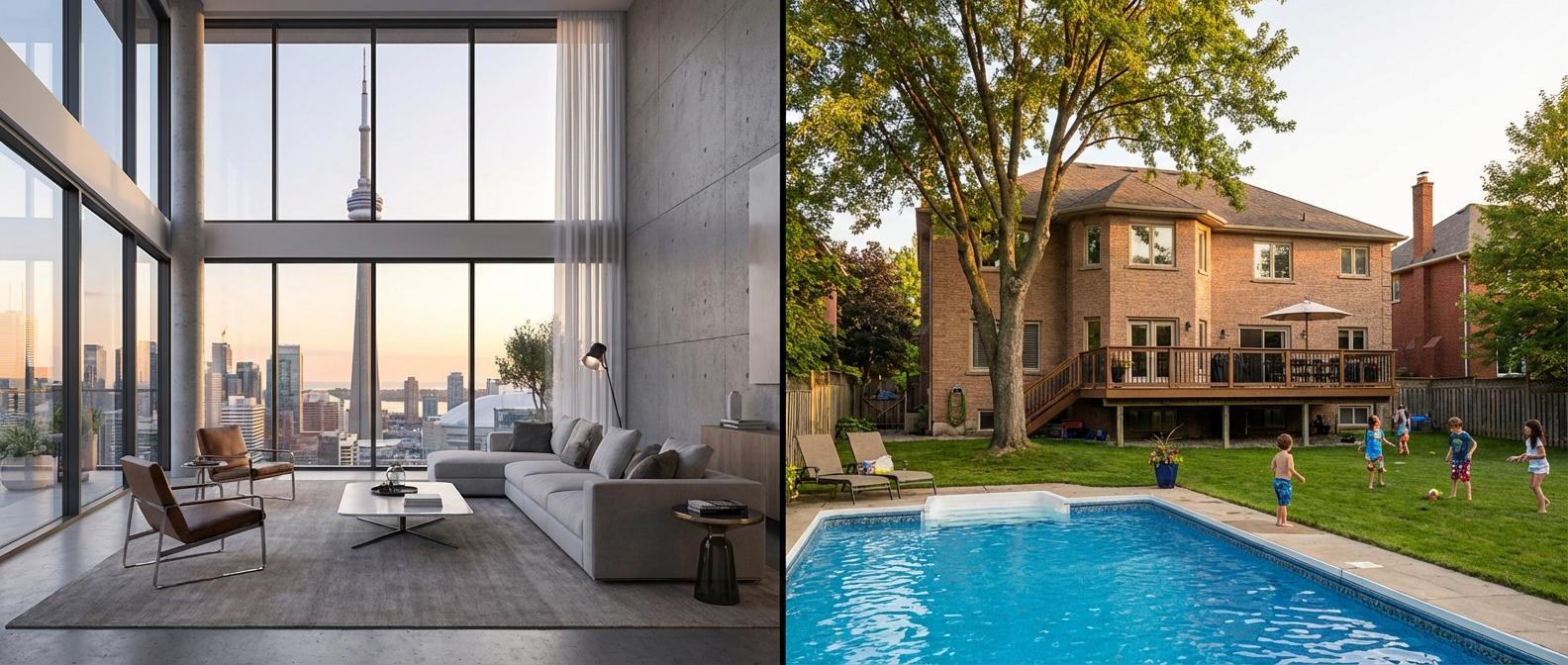
Condo vs House in the GTA: Complete Comparison for 2026
Condo123 · April 16, 2026
Condo vs House in the GTA: Complete Comparison for 2026
One of the most consequential decisions a GTA homebuyer faces in 2026 is not simply whether to buy — it is what to buy. The choice between a condo and a house shapes your finances, your lifestyle, your commute, and your long-term wealth-building strategy for years or even decades to come. With the Greater Toronto Area remaining one of North America's most complex and competitive real estate markets, the answer is rarely straightforward.
Whether you are a first-time buyer weighing your options, an investor evaluating returns, or a growing family assessing space requirements, this guide provides a thorough, data-driven comparison of condos versus houses in the GTA for 2026. We examine purchase prices, carrying costs, lifestyle trade-offs, investment performance, and much more — so you can make an informed decision that aligns with your personal and financial goals.
If you are just beginning your property search, you may also want to explore current pre-construction listings on condo123.ca to understand what is available in your budget and target neighbourhood before diving into this analysis.
The State of the GTA Real Estate Market in 2026
To properly compare condos and houses, you need to understand the market landscape in which you are buying. According to the Toronto Regional Real Estate Board (TRREB), the benchmark price for a detached home in the GTA reached approximately $1,412,000 in early 2026, while the benchmark price for a condominium apartment sat at approximately $698,000. That gap — roughly $714,000 — is not merely a number. It is the central driver behind almost every decision a GTA buyer must make in 2026.
Population growth in the Greater Toronto Area continues at a remarkable pace, with Statistics Canada projecting that the region will surpass 8 million residents by 2031. Demand for housing, both ownership and rental, remains structurally elevated. At the same time, interest rates — while having declined from the peak levels of 2023 — have stabilised in the 4.5% to 5.0% range for five-year fixed mortgages, according to Bank of Canada data from early 2026. This rate environment makes affordability calculations critical for any buyer entering the market.
The result is a market where the condo vs house debate is more relevant than ever. A property that costs twice as much does not necessarily deliver twice the utility — but it may deliver substantially more long-term equity growth, rental income potential, or quality of life, depending on your circumstances.
Price Comparison: What Does Each Property Type Actually Cost?
The most immediate difference between condos and houses in the GTA is purchase price. Below is a breakdown of average and benchmark prices across key segments as of early 2026.
| Property Type | City of Toronto (Avg.) | 905 Region (Avg.) | GTA Benchmark |
|---|---|---|---|
| Condo Apartment | $735,000 | $620,000 | $698,000 |
| Condo Townhouse | $890,000 | $780,000 | $835,000 |
| Semi-Detached House | $1,150,000 | $950,000 | $1,048,000 |
| Detached House | $1,580,000 | $1,245,000 | $1,412,000 |
Source: TRREB Market Watch, Q1 2026 (figures are approximate benchmarks for illustrative purposes)
These figures have significant implications for minimum down payments, mortgage qualifying, and total cost of ownership. Under Canada's current mortgage rules, a property priced above $1,500,000 requires a minimum 20% down payment — meaning a detached home in Toronto typically requires at least $316,000 down before you account for closing costs. A condo, by contrast, may qualify for as little as 5% down on the first $500,000 and 10% on the remainder, making the entry barrier dramatically lower.
For a full breakdown of what you will pay beyond the purchase price, read our detailed guide to Toronto closing costs in 2026, which covers land transfer taxes, legal fees, title insurance, and more.
Monthly Carrying Costs: The Full Picture
Purchase price is only one part of the financial equation. Monthly carrying costs — mortgage payments, maintenance fees, property taxes, utilities, and insurance — determine whether a property is genuinely affordable on an ongoing basis.
| Cost Category | Condo (Avg. $735K, Toronto) | Detached House (Avg. $1.58M, Toronto) |
|---|---|---|
| Mortgage Payment (25-yr amortisation, 4.75% rate, 20% down) | ~$3,380/month | ~$7,270/month |
| Property Tax (estimate) | ~$375/month | ~$820/month |
| Condo Maintenance Fee (avg. $0.75/sq ft) | ~$525/month | N/A |
| Home Insurance | ~$80/month | ~$200/month |
| Utilities (heat, hydro, water) | ~$100/month (partially included in fees) | ~$350/month |
| Maintenance Reserve / Repairs | ~$0 (covered by condo corp) | ~$500/month (1% rule estimate) |
| Estimated Total Monthly Cost | ~$4,460/month | ~$9,140/month |
The difference is stark: owning a detached house in Toronto costs approximately $4,680 more per month than owning a comparable condo. Over a year, that is roughly $56,160 in additional carrying costs. Over five years, it approaches $280,000 — and that figure does not account for the additional opportunity cost of the larger down payment required.
It is worth noting that condo maintenance fees vary significantly. Buildings with extensive amenities — concierge service, indoor pools, fitness centres, rooftop terraces — typically charge between $0.70 and $1.10 per square foot per month. Older buildings may carry higher fees due to deferred maintenance or special assessments. Always review the Status Certificate before purchasing any condo to assess the health of the reserve fund.
Space and Lifestyle: What Are You Actually Getting?
Beyond finances, the condo vs house decision is fundamentally about how you want to live. The following comparison outlines the key lifestyle differences between the two property types in a GTA context.
Living Space and Layout
The average new condo unit in Toronto offers approximately 650 to 750 square feet for a one-bedroom-plus-den and 850 to 1,050 square feet for a two-bedroom unit. A detached house in the GTA, by contrast, typically offers 1,800 to 2,500 square feet of above-grade living space, plus basement and outdoor areas. For families with children, this difference is often decisive. For single professionals or couples without children, a well-designed condo layout can feel entirely sufficient — particularly when the building provides amenity spaces that function as extensions of the private unit.
Outdoor Space
Houses in the GTA offer private yards that range from modest 25-foot lots in urban neighbourhoods to large suburban properties exceeding 7,500 square feet. Condos typically offer private balconies (averaging 50 to 150 square feet) plus shared rooftop terraces or outdoor lounges. For buyers who value gardening, outdoor entertaining, or space for children and pets, the yard associated with a house is a meaningful quality-of-life advantage.
Location and Walkability
This is where condos frequently win. The majority of GTA condo developments are located in urban cores — downtown Toronto, Midtown, North York, Etobicoke, and inner-ring 905 centres like Mississauga City Centre, Markham, and Oakville — where Walk Scores and Transit Scores are considerably higher. Walk Toronto data suggests that the downtown core has a Walk Score above 95, while many suburban house neighbourhoods score below 55. For buyers who rely on transit, cycle, or walk to work, a condo's urban location can save thousands of dollars annually in commuting costs and dozens of hours in travel time.
Parking and Storage
New condo developments in Toronto increasingly offer limited or no parking — a reflection of transit-oriented planning policy. In 2025, the City of Toronto removed minimum parking requirements from new developments, meaning many new buildings now offer parking spaces at an additional cost of $50,000 to $80,000 per spot. Storage lockers are typically sold separately for $5,000 to $15,000. Houses, by contrast, almost always include a garage and driveway, as well as substantial basement storage.
Investment Performance: Which Property Type Builds More Wealth?
For many GTA buyers, property is as much an investment as a home. Understanding how condos and houses have historically performed — and how they are likely to perform going forward — is essential to answering the question of whether you should buy a condo or house.
Historical Price Appreciation
Over the 20-year period from 2006 to 2026, detached houses in the City of Toronto appreciated at an average compound annual growth rate (CAGR) of approximately 7.2%, while condo apartments appreciated at approximately 6.4% CAGR over the same period, according to TRREB historical data. However, because houses start from a much higher base, the absolute dollar gains have been substantially larger for house owners — a detached home purchased for $400,000 in 2006 might be worth $1.58 million today, representing a $1.18 million gain, versus a condo purchased for $250,000 in 2006 that might now be worth $735,000, representing a $485,000 gain.
Rental Income Potential
Condos offer a significant advantage as rental investments. Average rents for a one-bedroom condo in Toronto reached approximately $2,280 per month in early 2026, according to Urbanation data. A two-bedroom condo rents for approximately $2,950 per month. These figures represent gross rental yields of approximately 3.7% to 4.5% on condo values — generally stronger than what house owners can achieve through basement suite rentals alone. Condos also benefit from professional property management services, making them more passive investments for landlords.
Pre-construction condos in particular offer investors the ability to secure a unit at today's pricing with a deposit structure spread over the construction period — typically 15% to 20% of the purchase price spread over two to three years. To explore current pre-construction opportunities across the GTA, browse available listings on condo123.ca.
Leverage and Return on Equity
A buyer who purchases a condo with 10% down ($73,500 on a $735,000 unit) and sees the property appreciate 5% in one year has made a $36,750 gain on a $73,500 investment — a 50% return on equity before carrying costs. The same leverage mathematics apply to houses, but the larger down payment required reduces the proportional leverage effect for many buyers.
Condo vs House: Side-by-Side Summary
| Factor | Condo | House | Advantage |
|---|---|---|---|
| Entry Price (GTA Benchmark) | ~$698,000 | ~$1,412,000 | Condo |
| Monthly Carrying Costs | ~$4,460 | ~$9,140 | Condo |
| Living Space | 650–1,050 sq ft | 1,800–2,500 sq ft | House |
| Outdoor Space | Balcony / shared amenities | Private yard | House |
| Location / Walkability | Urban core, Walk Score 75–97 | Suburban, Walk Score 40–65 | Condo |
| Maintenance Responsibility | Condo corporation | Owner | Condo |
| Rental Yield (Gross) | 3.7%–4.5% | 2.5%–3.2% | Condo |
| Long-Term Appreciation (CAGR) | ~6.4% | ~7.2% | House |
| Privacy | Shared building, common areas | Full private ownership | House |
| Flexibility / Modifications | Limited by condo rules | Full owner discretion | House |
| Suitability for Families | Limited for large families | Excellent | House |
| Investment / Entry Opportunity | Pre-construction available | Resale market primarily | Condo |
Who Should Buy a Condo in 2026?
A condo is likely the right choice if you match one or more of the following profiles:
- First-time buyers with limited savings: The lower entry price and down payment requirements make condos the most accessible path to home ownership in the GTA. If you are a first-time buyer, read our comprehensive first-time home buyer guide for Toronto 2026 before making any decisions.
- Urban professionals who value location: If proximity to work, restaurants, cultural amenities, and public transit matters to you, a condo in a central neighbourhood will deliver a superior lifestyle at a lower cost than a comparable house.
- Investors seeking rental income: Condo units in transit-accessible locations command strong rental demand and generate gross yields that outperform most house segments in the GTA.
- Buyers who prefer low-maintenance living: The condo corporation handles exterior maintenance, repairs, snow removal, and landscaping. This is especially appealing for frequent travellers or buyers who do not wish to spend weekends on home upkeep.
- Downsizers: Empty nesters looking to liquidate equity in a large family home and move to a more manageable space with urban amenities are a natural fit for condo living.
Who Should Buy a House in 2026?
A house is likely the better choice if you identify with these circumstances:
- Growing families: Multiple bedrooms, a private yard, proximity to good schools, and the freedom to renovate for your family's needs are all difficult to replicate in a condo environment.
- Buyers prioritising long-term wealth accumulation: Over 20-plus year horizons, detached houses in the GTA have consistently delivered stronger absolute dollar appreciation, particularly on larger lots in established neighbourhoods.
- Those who value autonomy and privacy: A house offers complete control over your living environment — no condo board approvals, no noise complaints from neighbours through shared walls, no restrictions on pets or renovations.
- Buyers who can afford the carrying costs: If your household income comfortably supports a $9,000-plus monthly all-in housing cost, a house provides space, flexibility, and generational wealth-building potential that condos cannot match.
- Buyers planning to add a rental suite: A basement apartment in a house can generate $1,800 to $2,500 per month in rental income, meaningfully offsetting carrying costs and improving the investment case for a higher purchase price.
The Rent vs Buy Dimension
Before committing to either a condo or a house, it is worth asking a more fundamental question: should you be buying at all in 2026? The answer depends on your financial stability, career trajectory, family plans, and tolerance for the illiquidity that comes with home ownership. To explore this question rigorously, read our analysis of renting versus buying in Toronto for 2026.
What the data generally shows is that buyers who plan to hold a property for fewer than five years may find that transaction costs — land transfer taxes, legal fees, moving costs, and real estate commissions upon sale — erode or eliminate any equity gains made during a short holding period. Whether you choose a condo or a house, a minimum five-year ownership horizon is advisable in the current GTA market.
Pre-Construction Condos: A Unique 2026 Opportunity
One factor that distinctly favours condos in 2026 is the availability of pre-construction inventory. Unlike houses, which are purchased almost exclusively on the resale market, condos can be purchased directly from developers during the pre-construction phase — often before the building breaks ground.
Pre-construction condos offer several unique advantages. First, the deposit structure — typically 5% at signing, 5% at 30 days, 5% at 90 days, and 5% at 365 days — allows buyers to control an asset worth hundreds of thousands of dollars with a fraction of the capital tied up at any given time. Second, during a rising market, buyers can benefit from appreciation throughout the construction period, which typically spans two to four years. Third, new units come with Tarion warranty protection, covering structural defects for up to seven years.
The GTA pre-construction market in 2026 includes projects spanning from the downtown core to emerging hubs in Scarborough, North York, Etobicoke, Mississauga, Brampton, and Hamilton. Prices range from under $600,000 for studios and one-bedroom units to over $1.5 million for penthouse and three-bedroom suites. To explore what is currently available, view pre-construction condo listings across the GTA on condo123.ca.
Frequently Asked Questions
Is it better to buy a condo or house in Toronto in 2026?
There is no single correct answer, as the decision depends on your budget, lifestyle, family situation, and investment goals. Condos offer a more accessible entry price (GTA benchmark of approximately $698,000 versus $1,412,000 for detached houses), lower monthly carrying costs, and prime urban locations. Houses offer more space, greater privacy, stronger long-term appreciation in absolute dollar terms, and more flexibility for growing families. Most buyers should assess their five-year life plan and financial capacity before deciding.
What is the average condo maintenance fee in Toronto in 2026?
The average condo maintenance fee in Toronto in 2026 is approximately $0.75 per square foot per month, meaning a 700-square-foot unit would carry fees of approximately $525 per month. Buildings with premium amenities such as concierge service, indoor pools, and fitness centres may charge $0.90 to $1.10 per square foot. Older buildings may charge higher fees if they are dealing with deferred maintenance or underfunded reserve funds. Always review the Status Certificate before purchasing a resale condo to assess the financial health of the corporation.
Do condos appreciate as fast as houses in the GTA?
Historically, detached houses in the GTA have appreciated at a slightly higher CAGR — approximately 7.2% over the past 20 years — compared to condos at approximately 6.4% over the same period. However, because condos can be purchased at a lower price point, they offer higher proportional returns when leveraged with smaller down payments. Additionally, condos in transit-oriented urban locations have shown strong resilience during market corrections, partly due to sustained rental demand from a growing population.
Can I rent out my condo in Toronto?
Yes, you can rent out a condo in Toronto, subject to the condominium corporation's rules and Ontario's Residential Tenancies Act. Most condo corporations allow rental units, although some impose registration requirements or guest policies that affect short-term rentals. Long-term rentals (one year or more) are protected under the Residential Tenancies Act, which means landlords must follow prescribed processes for rent increases and tenant terminations. Average long-term rental rates for a one-bedroom condo in Toronto reached approximately $2,280 per month in early 2026, according to Urbanation data.
How much do I need to earn to afford a house in Toronto in 2026?
Based on a detached house at the Toronto average of approximately $1,580,000, a 20% down payment of $316,000, and a 25-year amortisation at 4.75%, the monthly mortgage payment alone would be approximately $7,270. Adding property taxes, insurance, and maintenance, total carrying costs approach $9,140 per month. Under Canada's stress test (which qualifies buyers at the greater of 5.25% or the contract rate plus 2%), you would need a qualifying rate of approximately 6.75%. This implies a required household income of approximately $290,000 to $330,000 to qualify for this mortgage, depending on other debts and lender criteria.
Are pre-construction condos a good investment in the GTA in 2026?
Pre-construction condos can be a compelling investment in the GTA for buyers who have a long time horizon and understand the risks involved. The key advantages include a spread-out deposit structure, Tarion warranty coverage on new construction, and the potential for appreciation during the construction period. The risks include construction delays (two to four years is typical), the possibility of market conditions shifting before closing, and occupancy fees charged before the unit is registered. Investors should carefully evaluate the developer's track record, the building's location, and the projected rental demand in the area before committing.
What closing costs should I budget for when buying a condo or house in Toronto?
Closing costs in Toronto are significant and are often underestimated by first-time buyers. For a property in the City of Toronto, you will pay both the provincial and municipal land transfer taxes, which combined represent approximately 3.5% to 4.0% of the purchase price for amounts above $2 million and approximately 1.5% to 2.5% for properties in the $700,000 to $1,000,000 range. Additional costs include legal fees (approximately $1,500 to $2,500), title insurance ($300 to $500), home inspection fees ($400 to $600 for houses), and the HST on new construction (though this is often built into the purchase price on pre-construction condos). Budget a total of 2% to 4% of the purchase price for closing costs. For a detailed breakdown, read our guide to Toronto closing costs in 2026.
Final Thoughts: Making the Right Choice for You
The condo vs house debate in the GTA ultimately comes down to a deeply personal calculation that balances financial capacity, lifestyle preferences, family needs, and long-term goals. There is no universally correct answer — only the answer that is right for your specific circumstances in 2026.
What is clear is that both property types offer genuine pathways to home ownership and wealth building in one of Canada's most dynamic real estate markets. Condos democratise access to ownership, offer urban lifestyles at a more accessible price point, and generate competitive rental income. Houses provide space, privacy, flexibility, and a proven track record of long-term appreciation that has made detached property in the GTA one of the most reliable wealth-building assets in Canadian financial history.
If you are leaning toward a condo — particularly a pre-construction unit — the current 2026 market presents a range of compelling opportunities across the GTA. Developers are offering competitive incentive programmes and flexible deposit structures designed to make new ownership accessible. Whether you are a first-time buyer, an experienced investor, or someone returning to the market after a period of renting, there are options worth exploring.
Begin your search by browsing pre-construction condo listings across the GTA on condo123.ca, and consult a licensed mortgage professional to stress-test your budget before making any commitments. The most expensive mistake any buyer can make is purchasing a property — condo or house — that strains their finances beyond a sustainable level. With the right preparation and professional guidance, your 2026 purchase can form the foundation of lasting financial security.