

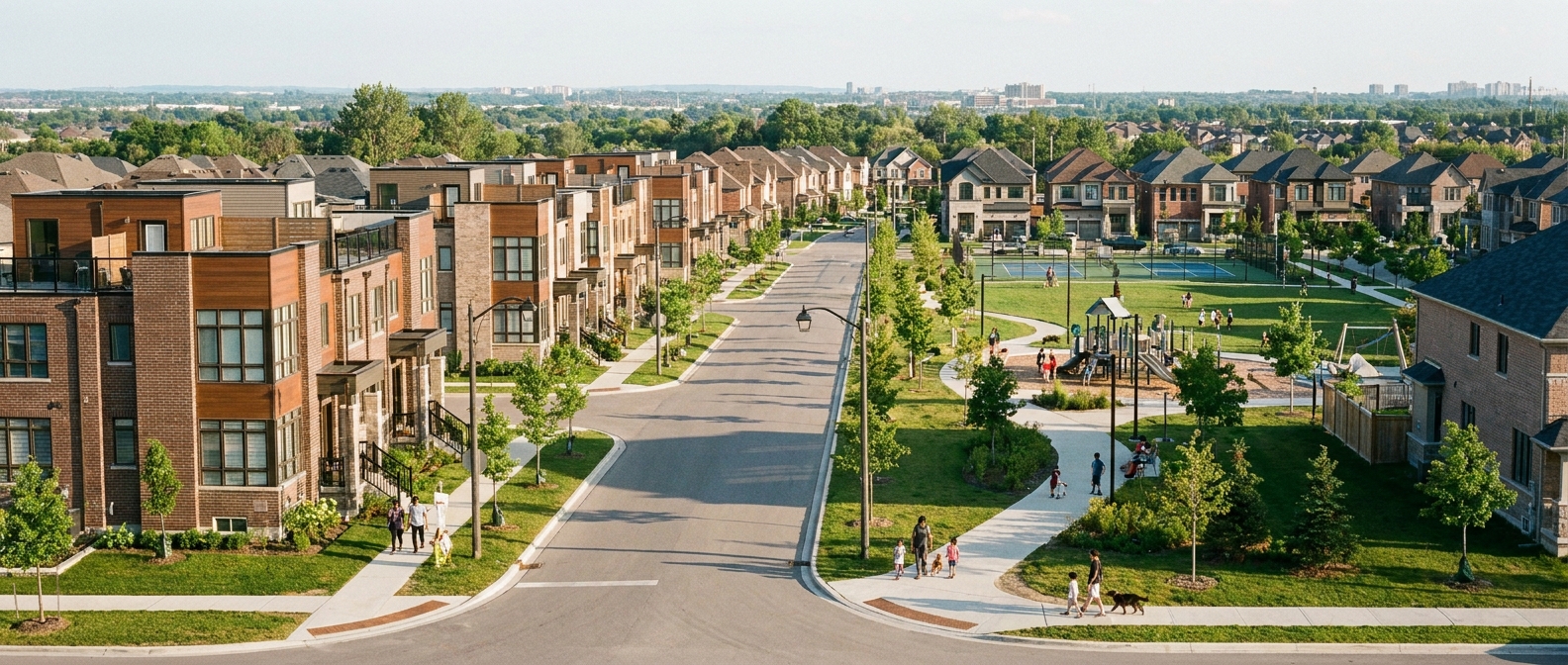
Best Neighbourhoods in Brampton for First-Time Buyers 2026
Condo123 · April 20, 2026
Best Neighbourhoods in Brampton for First-Time Buyers in 2026
Brampton has quietly become one of the most compelling stories in Greater Toronto Area real estate. Once overshadowed by its neighbours Mississauga and Toronto, this rapidly growing city of over 660,000 residents has emerged as a genuine destination for first-time buyers who want space, value, and long-term appreciation potential — without sacrificing connectivity to Canada's economic core. If you are researching Brampton real estate for the first time, you have chosen an excellent moment to start.
According to the Building Industry and Land Development Association (BILD), Brampton consistently ranks among the top three municipalities in the GTA for new housing starts, with over 4,200 new residential units registered in 2024 alone. Average benchmark prices for ground-oriented homes in Brampton hovered around $1,050,000 in late 2024, compared to over $1,400,000 in Toronto proper — a gap that continues to attract budget-conscious first-time buyers who do not want to compromise on quality of life.
This guide examines the best neighbourhoods in Brampton for first-time buyers heading into 2026, with detailed data on pricing, transit access, school quality, and community character. Whether you are drawn to a quiet suburban enclave or a vibrant, walkable mixed-use corridor, Brampton offers a remarkable variety of options. We will also point you toward pre-construction opportunities — often the most accessible entry point for buyers who need time to save and want to lock in today's pricing before further appreciation occurs.
For a broader look at emerging GTA communities worth watching, visit our guide on up-and-coming GTA areas in 2026. You can also discover active pre-construction projects across Brampton and the wider GTA on our platform right now.
Why Brampton Deserves Your Attention in 2026
Before diving into specific neighbourhoods, it is worth understanding the macro forces making where to buy in Brampton such a relevant question in 2026. Several structural factors distinguish Brampton from other GTA municipalities:
- Population growth: Brampton's population is projected to reach 900,000 by 2041, according to the Region of Peel's official growth plan. That trajectory creates sustained housing demand and supports long-term price appreciation.
- Infrastructure investment: The federal and provincial governments have committed over $1.3 billion toward the Hazel McCallion LRT line extension, which will dramatically improve east-west transit connectivity across Brampton and Mississauga.
- Employment base: Brampton is home to over 10,000 businesses, including major logistics hubs, Amazon distribution centres, and a burgeoning life sciences corridor near the Brampton Innovation District.
- Affordability window: Despite strong growth, Brampton's average benchmark condo price remains below $700,000 as of late 2024, according to the Toronto Regional Real Estate Board (TRREB). That figure represents a meaningful discount to comparable Toronto units.
- Pre-construction pipeline: Brampton has one of the most active pre-construction pipelines in the GTA, offering first-time buyers the opportunity to use extended deposit structures and phased payment schedules to enter the market at lower capital thresholds.
If you have not yet secured financing, we strongly recommend reading our comprehensive mortgage pre-approval guide for GTA buyers in 2026 before making any commitments. Understanding your borrowing capacity will clarify which of the neighbourhoods below falls within your realistic price range.
How We Evaluated Each Neighbourhood
Our analysis of the best neighbourhoods in Brampton used a consistent evaluation framework across six dimensions:
- Average resale and pre-construction pricing (TRREB data, Q3 2024)
- Transit score (Walk Score platform, Brampton Transit and GO Transit access)
- School performance (Ontario School Rankings via Fraser Institute, 2023 edition)
- Appreciation trend (5-year price change, 2019–2024)
- Pre-construction availability (active projects registered with Tarion)
- Lifestyle amenities (parks, retail, dining, recreation)
The 7 Best Neighbourhoods in Brampton for First-Time Buyers
1. Mount Pleasant: The Transit-Oriented Star
Mount Pleasant is arguably the most strategically positioned neighbourhood for first-time buyers who commute to Toronto. Built around the Mount Pleasant GO Station, this master-planned community offers direct Kitchener GO Line service to Union Station in approximately 45 minutes during peak hours. That connectivity alone justifies the premium many buyers are willing to pay relative to other Brampton communities.
Developed largely over the past 15 years, Mount Pleasant features a blend of townhomes, semi-detached houses, and an increasing number of mid-rise condo projects responding to intensification policies around the GO station. Average resale townhome prices in Mount Pleasant ranged from $850,000 to $970,000 in Q3 2024, while pre-construction stacked townhome units near the station launched at approximately $620,000 to $720,000 during the same period.
The neighbourhood earned a Walk Score of 62 and a Transit Score of 52 — respectable figures for a suburban Brampton community, and significantly higher than many competing areas. The Mount Pleasant Village Core offers a curated retail and dining district designed with pedestrian connectivity in mind, a rarity in newer suburban development patterns.
For first-time buyers who prioritise commute reduction and long-term transit-corridor appreciation, Mount Pleasant is the clear frontrunner in Brampton.
2. Bram West: Premium Value on the Mississauga Border
Situated in the southwest corner of Brampton, Bram West occupies a unique position: it borders Mississauga directly and benefits from proximity to Highway 407 and the Financial District employment clusters in Meadowvale. This makes it exceptionally popular with buyers who work in western Mississauga or who commute by car to Pearson Airport and surrounding logistics corridors.
Bram West is characterised by larger lot sizes, executive-style detached homes, and a higher proportion of new construction. Average detached home prices in this area ranged from $1,100,000 to $1,350,000 in Q3 2024, which places it above the Brampton average but well below comparable product in Mississauga's Erin Mills or Streetsville communities.
Pre-construction activity in Bram West has been particularly active, with several builders offering 40-foot and 50-foot detached lot products targeting move-up buyers and high-income first-time purchasers. Builders such as Mattamy Homes, Rosehaven Homes, and Tribute Communities have all delivered product in or adjacent to this corridor in recent years.
The neighbourhood is served by Brampton Transit routes connecting to the Mississauga Transitway, and the planned Hazel McCallion LRT extension is expected to improve north-south connectivity significantly once complete. School performance in Bram West is among the strongest in Brampton, with several elementary schools scoring in the 7.5 to 8.5 out of 10 range on the Fraser Institute's annual rankings.
3. Springdale: Established, Affordable, and Family-Friendly
Located in northeast Brampton, Springdale has been a first-time buyer favourite for over a decade. Developed primarily between 2000 and 2012, the neighbourhood now offers relatively mature tree coverage, established parks, and a proven community infrastructure that newer master-planned communities simply cannot replicate.
What makes Springdale particularly compelling for 2026 buyers is its pricing accessibility. Semi-detached homes were transacting at an average of $850,000 to $920,000 in Q3 2024, while detached homes in the $980,000 to $1,100,000 range remain findable for buyers willing to take on modest cosmetic renovation projects. Those numbers represent some of the best value-per-square-metre ratios available in the Brampton market.
Springdale is served by multiple Brampton Transit routes and benefits from proximity to Highway 410, which connects commuters to Mississauga and Toronto in approximately 30 to 40 minutes under normal conditions. The Springdale Community Centre and Library serves as a genuine neighbourhood hub, offering programming for all age groups year-round.
Families will find the school options in Springdale solid. Trinity Common Mall, one of Brampton's larger retail centres, is located nearby, providing comprehensive day-to-day retail convenience.
4. Fletchers Meadow: Schools, Safety, and Suburban Stability
Fletchers Meadow, situated in northwest Brampton, has developed a reputation among young families as one of the most liveable suburban communities in the entire GTA. It consistently earns praise for its school quality, community safety metrics, and the overall sense of neighbourhood cohesion that distinguishes established communities from rapidly changing ones.
The neighbourhood's flagship educational asset is Sandalwood Heights Secondary School, which has consistently ranked among the top 20% of Ontario secondary schools in the Fraser Institute's annual performance index. For first-time buyers with young children or planning to start families, this kind of established academic reputation creates both personal value and real estate demand resilience.
Pricing in Fletchers Meadow is broadly accessible by Brampton standards. Semi-detached homes averaged approximately $870,000 to $940,000 in Q3 2024, while freehold townhomes — a popular entry point for first-time buyers — were transacting in the $780,000 to $850,000 range. These figures place meaningful home ownership within reach for dual-income households earning in the $140,000 to $160,000 combined annual income range, depending on down payment levels.
Fletchers Meadow also benefits from proximity to Brampton Civic Hospital, one of the largest acute-care facilities in the GTA, which provides both healthcare access and a significant local employment anchor.
5. Credit Valley: Green Spaces and Upmarket Appeal
Credit Valley, located in southwest Brampton adjacent to the Credit River, offers a distinctly different lifestyle proposition from the denser, more urban-influenced communities closer to the GO corridor. If you prioritise green space, natural landscapes, and a quieter pace of suburban life, Credit Valley deserves serious consideration.
The Credit River valley offers extensive trail networks, conservation areas, and genuine ecological diversity — an increasingly rare amenity in rapidly urbanising GTA communities. The neighbourhood itself is predominantly composed of large detached homes on generous lots, with several golf courses and recreation facilities nearby.
Pricing in Credit Valley reflects its premium character. Detached homes averaged $1,150,000 to $1,350,000 in Q3 2024, and new pre-construction detached product in adjacent communities launched at similar price points. This places Credit Valley at the higher end of the first-time buyer spectrum, though it remains accessible to high-income earners who might otherwise be looking at Oakville or Burlington.
Five-year appreciation in Credit Valley has been strong. Median detached home values increased by approximately 38% between 2019 and 2024, outperforming the broader Brampton average of approximately 29% over the same period, according to TRREB historical data. This suggests the neighbourhood's premium has been durable and is likely to persist as the area's established character becomes increasingly scarce in a densifying region.
6. Castlemore: Luxury Lots at a Significant Discount to Toronto
Castlemore, situated in northeast Brampton near Highway 427 and Claireville Conservation Area, occupies a distinct niche: it offers the largest lots and most architecturally ambitious homes in Brampton at prices that would be inconceivable for comparable product in North York or Richmond Hill.
Semi-estate and estate-style homes in Castlemore typically sit on lots ranging from 60 to over 150 feet in width. Homes of 3,000 to 5,000 square feet are common, and detached prices in Q3 2024 ranged from $1,350,000 to over $2,000,000 depending on lot size and build quality. For a first-time buyer, this neighbourhood is relevant primarily if you are entering with significant financial resources — perhaps through equity from a family property or a strong dual-income professional household.
The neighbourhood is car-dependent, with Transit Scores below 40 for most addresses. However, Highway 427 and the 407 ETR provide excellent regional road connectivity, and Pearson International Airport is accessible within approximately 20 minutes. For buyers whose lifestyle and career centre around air travel or west-end employment, Castlemore's location is a genuine strategic advantage.
7. Brampton East (Heart Lake): Rediscovery Value
Heart Lake, encompassing much of the Brampton East community, is perhaps the most undervalued neighbourhood on this list relative to its fundamentals. Located near Heart Lake Conservation Area — one of the GTA's most accessible swimming and recreation destinations — this older Brampton community offers mature infrastructure, generous lot sizes, and pricing that reflects its quieter profile rather than its genuine quality of life.
Detached homes in Heart Lake averaged approximately $950,000 to $1,050,000 in Q3 2024, while semi-detached homes were available in the $820,000 to $890,000 range. These prices are notable because many properties in the area sit on oversized lots with mature landscaping — characteristics that command significant premiums in comparable communities.
Heart Lake Conservation Area itself spans over 247 hectares and offers swimming, fishing, hiking, and winter trail activities within walking distance of many neighbourhood addresses. This concentration of natural amenity is genuinely rare within the GTA's urban boundary and constitutes a quality-of-life advantage that is difficult to quantify but easy to appreciate.
Brampton Transit service connects Heart Lake to downtown Brampton and the Brampton GO Station, though frequency is moderate. As Brampton's transit investment programme matures through 2026 and beyond, Heart Lake's connectivity is expected to improve.
Brampton Neighbourhood Comparison Table
| Neighbourhood | Avg. Detached Price (Q3 2024) | Avg. Townhome Price | Transit Score | Fraser School Rating | 5-Year Appreciation | Best For |
|---|---|---|---|---|---|---|
| Mount Pleasant | $1,050,000 | $680,000 | 52 | 7.0 / 10 | ~34% | GO Commuters |
| Bram West | $1,200,000 | $790,000 | 45 | 8.0 / 10 | ~31% | Mississauga Workers |
| Springdale | $1,020,000 | $810,000 | 48 | 6.8 / 10 | ~28% | Value Seekers |
| Fletchers Meadow | $990,000 | $820,000 | 44 | 8.2 / 10 | ~30% | Young Families |
| Credit Valley | $1,280,000 | $870,000 | 38 | 7.5 / 10 | ~38% | Nature Lovers |
| Castlemore | $1,650,000 | N/A | 32 | 7.2 / 10 | ~36% | Estate Buyers |
| Heart Lake | $990,000 | $840,000 | 41 | 6.5 / 10 | ~26% | Conservation Access |
Pre-Construction in Brampton: The First-Time Buyer Advantage
One of the most significant structural advantages available to first-time buyers in Brampton is the breadth of the pre-construction market. Unlike established resale properties, pre-construction condos and townhomes typically allow buyers to:
- Secure a purchase price today with a deposit structure spread over 12 to 24 months (commonly 5% at signing, 5% at 90 days, 5% at 180 days, and 5% at occupancy)
- Benefit from any market appreciation that occurs during the construction period without needing to carry a mortgage in the interim
- Access Tarion warranty protection covering defects in materials and workmanship for up to 7 years on major structural components
- Utilise the First Home Savings Account (FHSA) and the Home Buyers' Plan (HBP) simultaneously, potentially contributing up to $40,000 from an FHSA and $35,000 from RRSP funds ($70,000 for couples) toward a pre-construction deposit
Brampton has seen launches from some of Canada's most reputable builders in recent years. Active or recently completed pre-construction projects have included developments from Mattamy Homes, Lindvest, Fieldgate, Rose Corporation, and Daniels — each offering distinct product types tailored to different buyer profiles.
You can explore currently available pre-construction opportunities in Brampton and across the GTA by visiting our project discovery platform, which is updated continuously as new phases and projects are released.
What First-Time Buyers Should Budget for in Brampton
Understanding the full cost of purchasing a home in Brampton is essential to avoiding unpleasant financial surprises. Beyond the purchase price itself, first-time buyers should budget for the following:
| Cost Item | Typical Range | Notes |
|---|---|---|
| Land Transfer Tax (Ontario) | $8,475 on $850,000 | First-time buyers receive a rebate of up to $4,000 |
| Legal Fees | $1,500 – $2,500 | Including disbursements and title search |
| Home Inspection | $400 – $650 | Resale only; not applicable to pre-construction |
| Title Insurance | $250 – $400 | One-time premium; strongly recommended |
| CMHC Mortgage Insurance | 2.80% – 4.00% of insured amount | Required when down payment is below 20% |
| Development Charges (Pre-Con) | $30,000 – $60,000+ | Charged at occupancy; amounts vary by project |
| Moving Costs | $1,200 – $3,500 | Depending on volume and distance |
| Property Tax (Annual) | ~$5,500 – $8,000 | Based on assessed value; Peel Region rate applies |
For a detailed walkthrough of how Canadian mortgage rules apply to your specific situation, including stress test implications and insured vs. conventional loan thresholds, read our complete mortgage pre-approval guide for GTA buyers in 2026.
Brampton Real Estate Outlook for 2026
The outlook for Brampton real estate heading into 2026 is cautiously optimistic. The Bank of Canada's rate-cutting cycle, which began in June 2024, has improved affordability conditions meaningfully for variable-rate borrowers and has encouraged lenders to offer more competitive five-year fixed rates. As of late 2024, five-year fixed insured mortgage rates were available in the 4.50% to 4.80% range, representing a significant improvement from the peak of 5.50%+ seen in 2023.
Population growth remains Brampton's most durable demand driver. Peel Region continues to receive a disproportionate share of Ontario's newcomer population, and the federal government's immigration targets — even if modestly adjusted from their 2024 levels — continue to support household formation in the suburban GTA at rates that fundamentally underpin housing demand.
Supply constraints are also relevant. Ontario's housing construction targets have proven extremely difficult to meet due to labour shortages, development charge disputes between municipalities and the province, and elevated construction costs. The BILD reported that the GTA needs approximately 125,000 new homes per year to meet population growth targets but has been delivering closer to 38,000 to 45,000 annually in recent years. That gap creates structural upward pressure on prices, particularly in municipalities like Brampton where employment growth and immigration continue to accelerate.
For first-time buyers, the implication is clear: waiting for a dramatic price correction is unlikely to be a rewarding strategy. Entering the market with a sound financial plan, a clear understanding of your neighbourhood priorities, and the support of experienced professionals is a far more reliable approach to building long-term wealth through real estate.
If you are a first-time buyer and want a comprehensive guide to the entire purchase process in the Toronto and GTA context, our first-time home buyer guide for 2026 covers every step from pre-approval to closing day.
Frequently Asked Questions
What is the average home price in Brampton in 2026?
Based on Q3 2024 TRREB data and projected growth rates, average home prices in Brampton for 2026 are expected to range from approximately $900,000 to $1,150,000 for ground-oriented homes, depending on property type and neighbourhood. Condominiums and stacked townhomes in transit-oriented locations continue to offer entry points below $700,000 for first-time buyers, particularly through pre-construction purchase agreements that lock in pricing before delivery.
Which Brampton neighbourhood is best for first-time buyers with a budget under $900,000?
Buyers with a budget under $900,000 in Brampton have several viable options. Fletchers Meadow and Springdale both offer freehold townhomes and semi-detached homes within this range. Heart Lake also offers solid value for buyers who prioritise green space. Pre-construction stacked townhomes and condo units in Mount Pleasant and other transit-oriented communities are also accessible at this price point, often with deposit structures that reduce the immediate capital requirement.
Is Brampton a good long-term investment for real estate?
Brampton demonstrates strong long-term investment fundamentals. Key indicators include population growth projected at roughly 240,000 additional residents by 2041, significant infrastructure investment in transit and road networks, a diversifying employment base across logistics, life sciences, and technology, and persistent housing supply shortfalls across the GTA. Benchmark home prices in Brampton increased by approximately 29% on average between 2019 and 2024 despite the market correction of 2022 to 2023. Premium neighbourhoods such as Credit Valley and Castlemore saw appreciation closer to 36% to 38% over the same period.
How long does the commute from Brampton to Toronto take?
Commute times from Brampton to Toronto vary significantly by neighbourhood and mode of transport. From Mount Pleasant GO Station, Kitchener Line trains reach Union Station in approximately 45 minutes during peak service. From Brampton GO Station in the downtown core, trains to Union Station take approximately 50 to 55 minutes. By car, commutes from Brampton to downtown Toronto typically range from 40 to 70 minutes depending on traffic conditions and time of departure. The planned Hazel McCallion LRT extension is expected to improve east-west connectivity and reduce transfer times for Peel Region commuters significantly upon completion.
What are development charges and how do they affect pre-construction buyers in Brampton?
Development charges are fees levied by the City of Brampton and the Region of Peel on new residential construction to fund the infrastructure required to service new development — roads, water, transit, and community facilities. For pre-construction buyers, development charges are typically payable at the time of occupancy rather than at signing. These charges can range from $30,000 to over $60,000 for ground-oriented units in Brampton and represent a significant closing cost that buyers must plan for carefully. Always review the Statement of Critical Dates and Schedule B of your Agreement of Purchase and Sale to understand your exposure to development charge increases before signing.
Should I buy resale or pre-construction as a first-time buyer in Brampton?
Both options carry distinct advantages. Resale purchases offer immediate occupancy, the ability to physically inspect the property, and certainty about what you are purchasing. Pre-construction offers lower initial capital requirements through phased deposit structures, Tarion warranty protection, the opportunity to customise finishes, and the potential for appreciation during the construction period. Many first-time buyers in Brampton favour pre-construction because the deposit schedule — typically spread over 18 to 24 months — provides additional time to save while the purchase is already contractually secured. However, pre-construction carries risks including project delays, builder insolvency, and development charge uncertainties that require careful due diligence.
How do I qualify for the First-Time Home Buyer Incentive or other government programmes as a Brampton buyer?
The federal First-Time Home Buyer Incentive programme was formally wound down in March 2024. However, first-time buyers in Brampton can still access meaningful government support through the First Home Savings Account (FHSA), which allows contributions of up to $8,000 per year and $40,000 lifetime on a tax-deductible basis with tax-free withdrawals for qualifying home purchases. The Home Buyers' Plan (HBP) allows eligible first-time buyers to withdraw up to $35,000 per person ($70,000 per couple) from RRSP accounts for a home purchase, with repayment spread over 15 years. Ontario's Land Transfer Tax rebate of up to $4,000 is also available to first-time buyers. Combining these programmes can meaningfully reduce the effective upfront cost of purchasing a home in Brampton.